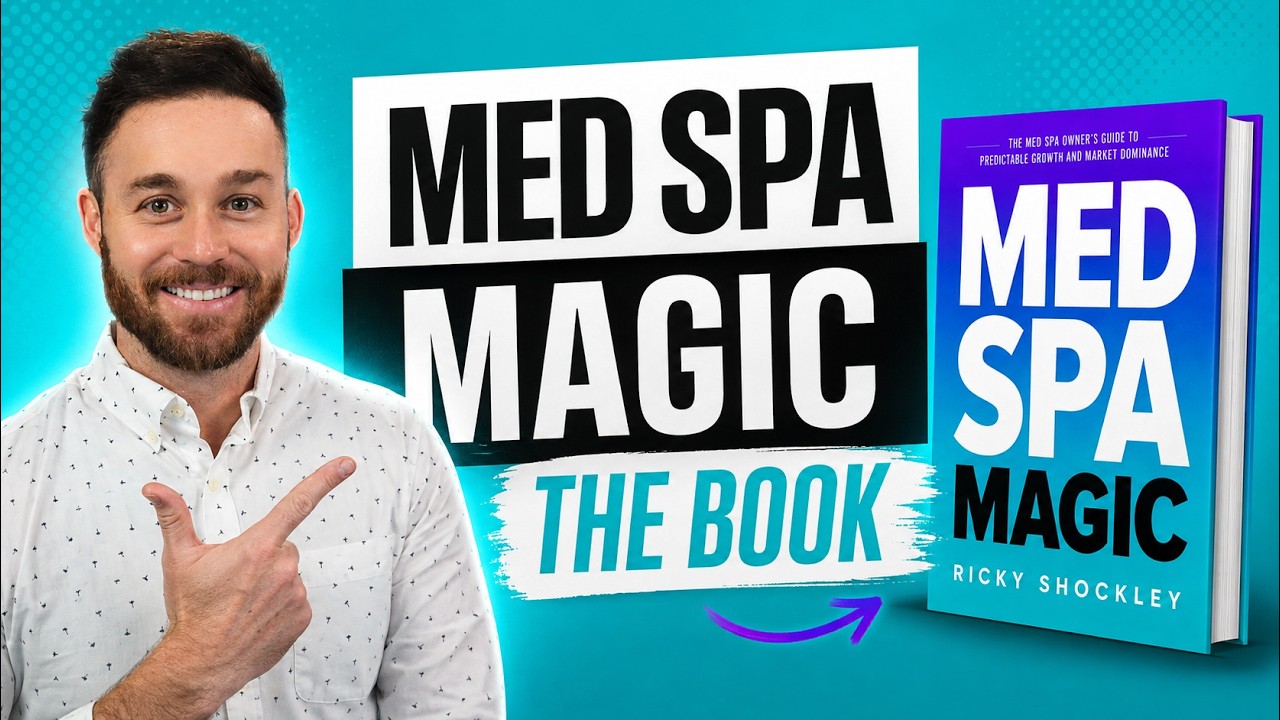
I started writing this book over four years ago, and for a long time, I kept pausing on completion—wondering and feeling like it wasn’t quite good enough, like there was something missing. Looking back, I’m really glad I waited. Over the last six to seven months, I developed key nuances to the frameworks that guide our marketing strategy that I think really put a bow on our work and our methodology. Specifically, these nuances clarify how to set up and manage marketing results that are not hit-or-miss—results that are maximally effective and consistent—and how to understand that when things aren’t working, what probably needs to be adjusted and modified to make it work and to work better.
That is why I’m excited to roll out Med Spa Magic: The Med Spa Owner’s Guide to Predictable Growth and Market Dominance. We are also releasing an audio version chapter by chapter on the podcast. Here, we’ll walk through the book’s core premise, what we’re going to cover, and the foundational frameworks that set the stage for Chapter 1.
Why Med Spa Marketing Shouldn’t Feel Like a Guessing Game
Marketing your med spa should not feel like a guessing game. Too much of the advice floating around the aesthetics space is just a pile of disconnected tips:
- “Post more on social.”
- “Run more ads.”
- “Don’t discount.”
- “Discount.”
Even when tips like these are wrong, they leave you in the exact same spot where you started—spending money on marketing and hoping that it works, with no real framework for why you’re making the decisions you’re making and how to make sure you’re creating the best result moving forward.
Med Spa Magic takes a different approach. The book hands you the underlying model and frameworks—along with the nuance and the trade-offs behind how a med spa actually grows—so you can invest in your marketing with clarity and confidence instead of crossing your fingers. At the center of this system is the Growth Equilibrium Framework, which helps you understand the trade-offs every med spa faces:
- Volume versus value
- Cost versus quality
- Offers versus brand
Once you see the system and understand the framework, the guesswork disappears. You stop chasing the “perfect tactic” and start making deliberate decisions that fit your practice’s needs, your phase, and your goals—with a clear view of the risk and return in every move.
Drawing on more than a decade in medical aesthetics marketing and real results across a roster of national clients, this operating system holds nothing back. Here is what the book covers:
- The Growth Equilibrium: The model behind predictable growth, and why more bookings can quietly make you less money if you do it wrong.
- ECAC (Effective Customer Acquisition Cost): A metric I think I invented that tells you the truth about your marketing investment when your booking count might be lying.
- Offers and Discounting: The real trade-offs behind promotional offers and discounting so you can use them as a scalpel instead of a crutch.
- Patient Decision-Making: How patients actually choose a med spa, and how to win the moment they’re comparing you to the competition.
- Service Strategy & Front-Door Treatments: Which services to advertise, which to never advertise, and why toxins (“talks” / neurotoxins) serve as the front door to everything else in most med spas.
- Channel Sequencing: How to run Meta ads, Google SEO, and PR playbooks in the right order depending on your stage of growth.
- Brand Magnetism: How to build a brand so magnetic that people seek you out before they ever even see your ad.
- Patient Retention: A retention system that turns initial visits into loyal, high-value patients for years to come.
This is the same system my team has used to take clients from $30,000 a month to $120,000 a month, and to add up to $8 million in new, directly traceable revenue for some of our multi-location med spa groups. If you’re tired of inconsistent marketing advice that sounds good on paper but doesn’t hold up consistently over time, Med Spa Magic gives you something better: a clear model, honest trade-offs, and the confidence to finally know why your marketing is working and how to make it work harder.
The Growth Equilibrium Model
Let’s get into the core of transforming your business into the go-to med spa in your area, starting with the Growth Equilibrium.
The Iceberg Beneath Your Tactics
Before getting into tactics—which make up roughly the top 15% of the iceberg—it’s critical to step back. Most practice owners obsess over tactics without realizing that the bulk of sustainable success happens in the 80% of the iceberg underneath the water.
Before diving into specific plays, you need the mental model underneath all of them. Most owners collect marketing tactics like puzzle pieces without ever seeing the picture on the box. The Growth Equilibrium Framework is the picture on the box. Once you grasp it, every subsequent chapter becomes an application of the same handful of core ideas rather than a random list of things to try.
ECAC: The Metric That Reframes Everything
A great place to start is ECAC (Effective Customer Acquisition Cost), because it changes how you read every other number in your business.
Most owners measure marketing by how many appointments it books. That is the wrong number. Many owners have been conditioned to obsess over initial bookings as the primary yardstick of success, yet a full calendar does not account for patient quality, retention, or how much a patient is worth over time.
The number that actually matters is ECAC—Effective Customer Acquisition Cost: the cost to acquire a client who actually stays, not just someone who books once.
- Regular CAC tells you what you paid to get someone in the door.
- ECAC tells you what you paid to get someone who sticks.
The gap between those two numbers is where med spas quietly win or lose. It is often the difference between ads that appear successful and ads that fail—and a major reason marketing can feel so volatile. When you optimize for ECAC, the rest of the model falls into place.
Why Marketing Behaves Like a Closed System
Here is the first hard truth of the model: there is no perfect ad at the tactical level. There is no campaign that delivers high volume, low cost, high quality, and high retention all at once.
Med spa marketing behaves like a closed system. Every time you adjust one lever to improve a metric, the system pushes back somewhere else. You don’t eliminate the trade-off; you relocate it. I call this the Law of Marketing Equilibrium. Accepting this law is what separates owners who master their marketing from owners who spend years chasing a unicorn that doesn’t exist.
Balancing Marketing Friction and Operational Friction
Within this closed system, your business is constantly balancing two kinds of friction:
- Marketing friction is everything an ad has to overcome to convince a stranger to take action—such as a higher price point, a longer intake form, or brand-heavy messaging that asks for trust before the click.
- Operational friction is everything your team has to do to turn an acquired lead into a loyal, high-paying client—including the consultation, sales conversion, and follow-up.
When you lower marketing friction with an easy, cheap offer, the work doesn’t disappear; you transfer the burden onto operations. Conversely, when you raise marketing friction to attract pre-sold buyers, you ease your team’s operational burden, but you pay more upfront in acquisition cost. You are always paying somewhere—the only question is where.
Calibrating the Two Dials: Volume vs. Value
It helps to picture two dials on your marketing control panel:
- The Volume Dial (Low Marketing Friction): Accessible introductory offers on popular gateway services. This typically brings a lower acquisition cost, higher lead counts, mixed client quality, smaller average first ticket sales, and lower average retention.
- The Value Dial (High Marketing Friction): Brand-led positioning and full-price treatments. This brings a much higher upfront acquisition cost and lower lead counts, but attracts intentional, pre-sold, stickier patients.
Neither dial is inherently right or wrong. A brand-new med spa with empty chairs might intentionally turn toward the volume dial, whereas a mature med spa running near capacity might lean toward the value dial. The mistake is expecting one dial to give you the benefits of both. You can—and likely should—calibrate somewhere in between along the spectrum, while keeping a clear eye on the trade-offs as you move.
How Patients Keep Score: Reputation, Convenience, and Price
When a prospect chooses a med spa, they run a subconscious scorecard across three factors: reputation, convenience, and price.
- Reputation is the heavy hitter and the prerequisite. If it isn’t there, you aren’t really in the game—unless you are willing and able to win long-term on price alone by being the cheapest option in town, which is the sole exception.
- Convenience shapes the practical choice.
- Price acts as the tiebreaker for new patients, not the primary purchase lever.
We will dive much deeper into this in the chapter on the psychology of choosing you, but holding this hierarchy in mind now explains why the cheapest offer doesn’t automatically win—and why discounting to fix a reputation problem often backfires. We have seen that lesson play out firsthand through experience.
Foundations of Success
The “Cherry on Top” Doctrine
An offer can never be the foundation of your business or your advertising. It is the cherry, not the sundae.
The sundae is your patient experience, your reputation, your team, and the relationships you build with your prospects and patients. The cherry—the promotional offer—exists solely to nudge someone who is already considering treatment over the line to try you.
- Built on a bulletproof foundation, the cherry acts as an accelerant.
- Built on a weak foundation, it simply helps you fail faster and at scale.
The test is straightforward: if you are not confident your team can wow a new patient beyond belief on their first visit, efforts to attract new clients are likely doomed to fail. For prospective clients trying to find their new med spa home, a “B+” experience might as well be an “F,” because patients will keep looking and choose an alternative where they experience a true “A+” standard.
The Discounting Catch-22
One of the most common ways owners and marketers try to cheat the equilibrium is by discounting their way into higher acquisition numbers—specifically higher client counts. While that can move the needle at the ad level, it poisons the business over time: competing primarily on price attracts people who choose you only for the price and arrive with little intention of sticking around.
We will unpack discounting in full in its dedicated chapter, but as a rule of thumb, the med spas most tempted to discount their way out of trouble are usually the ones that can least afford the consequences.
Phased Growth Strategies
The Four Dominoes of Client Acquisition
Think of client acquisition as a stack of four dominoes:
- Brand and Reputation: The pre-sell that establishes authority before anyone sees your ad, and backs up the purchase decision once a prospect researches your practice.
- Creative Insulation: Advertising that pre-qualifies intent so your price doesn’t have to do all the heavy lifting in a promotion.
- Leads Management: The operational handoff where speed and diligent follow-up capture momentum.
- Monetization: Where your providers turn the first visit into a long-term relationship, maximizing ROI.
When all four dominoes are aligned, a light tap on the first one topples the entire row, and new patients move smoothly into loyalty. When even one is out of place, the chain breaks—and no amount of ad spend will fix it.
Diagnosing Your Phase (and a South Florida Salon Lesson)
Because everything is situational, your right next move always depends on where your business currently stands. Empty chairs may call for a volume-based approach, while a practice running full or near capacity is usually in an optimization phase that leans more into value and brand. Applying a growth-phase tactic to a mature practice—or a mature-practice tactic to an empty calendar—is one of the costliest and most common mistakes in the industry.
A real-world example from early in my career illustrates this phase shift cleanly. Not long after college, when I first met my wife, she managed an upscale pet salon for a local owner in South Florida. His playbook was simple and mirrors how newcomers break into markets across many industries: he opened with competitive pricing, while delivering genuinely luxury, high-end results.
Consider what that did to the scorecard. Reputation takes time to build, and you can’t move your physical location, but you can lower the price lever on day one. By pairing an accessible price with a level of service quality competitors couldn’t match, he created an offer that was hard to pass up—driving not just initial trial, but retention because the experience backed up the price. That combination built a loyal client base and a wall of five-star reviews early on, when he had no reputation to lean on. Then, as demand grew and reviews accumulated over roughly 18 to 24 months, he slowly and deliberately raised his prices until he became the most expensive salon in town—and clients happily paid because his earned reputation supported it.
That story captures the model in action: starting on the volume dial to win on price while over-delivering on quality to build reputation, and then rotating toward the value dial once that reputation earned the right to charge more. Instead of locking into one posture and standing still, he moved through phases intentionally—a dynamic that also applies when expanding into new locations.
Conclusion and Next Steps
Brand Equity: The One Force That Bends the Curve
Here is the most important takeaway of the entire model: from a pure offer-and-ad standpoint, you can only calibrate which trade-off you accept. However, there is one force that changes the underlying math of the entire system: brand equity.
When you become the obvious, undeniable choice in your market—a “market of one”—you can afford a higher acquisition cost because retention and referrals carry the math, allowing offers to return to their proper place as the cherry on top of the sundae. Building the brand is how you stop renting attention and start owning your market. It’s a big enough pillar that it gets its own chapter later in the book (and arguably merits even more).
Choosing Your Trade-Offs on Purpose
Ultimately, the model comes down to this: at the ad-tactical level, there is no strategy with only upside. Every real approach has a cost. Your job isn’t to find a mythical “perfect play.” It’s to choose your trade-offs intentionally, calibrate them to your current phase, and build a brand strong enough to bend the curve over time.
Keep this model in mind as we move forward, and the rest of the system will click into place. If you want to pick up a copy of Med Spa Magic, check the link in the show notes—I strongly encourage grabbing it for how it approaches marketing and managing a practice. And if you’re following along with the audio edition on the podcast, stay tuned for the next episode, where we jump into Chapter 1.
Leveling Up Your Digital Marketing with a One-on-One Strategy Call
For practice owners and marketing directors looking to improve and level up their digital marketing efforts, I also invite you to schedule a one-on-one strategy call with me. Our agency is rated five stars on Google, HIPAA-verified by Compliancy Group, and has a track record of taking clients from $30,000 a month to $120,000 a month while adding multi-millions of dollars in additional revenue for larger multi-location med spas through more effective marketing strategies.
The strategy call is designed to be genuinely educational: I spend roughly an hour walking through detailed reviews of the best-performing plays we run for our clients. You can take those insights and run with them on your own if that’s what you want to do, and if it looks like a good fit to work together, we’re excited about the possibility of partnering with you. To schedule a one-on-one strategy call, visit medspamagicmarketing.com.