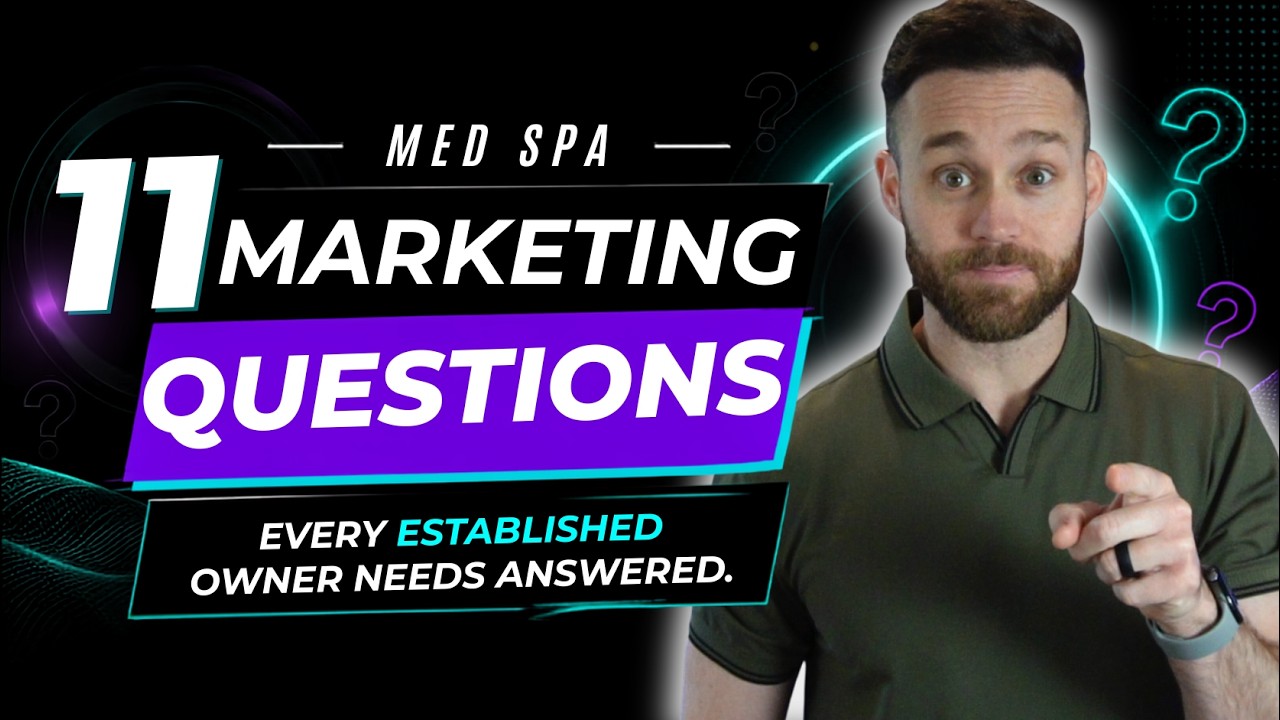
Managing a medical spa’s marketing investment requires more than just launching a few ads and hoping for the best. It requires strategic foresight, robust systems, and a clear understanding of consumer behavior. Based on the most frequently asked questions from top-performing med spa owners, this comprehensive guide addresses the most pressing concerns regarding digital marketing, patient acquisition, and operational alignment.
1. Overcoming EMR Limitations for Appointment Reminders
Most Electronic Medical Record (EMR) systems default to a reminder process that can actually hurt your business: asking the patient to confirm or cancel their appointment. For an existing client of three years, replying “Y” to confirm or “X” to cancel is perfectly acceptable. However, presenting this 50/50 proposition to a brand-new lead is essentially inviting them to second-guess their purchase decision.
If your EMR has limited capabilities, it is highly recommended to bridge the gap with a flexible CRM, such as GoHighLevel, or specific EMR add-ons like Aesthetic Record’s Lead AR or Zenoti’s custom tools.
To drastically reduce no-show rates—often dropping them from 40-50% down to 10-20%—implement a comprehensive, 5-to-7 step SMS and email drip campaign.
- The Timeline: Start the sequence 40 days out for follow-up appointments, or 10 days out for upcoming bookings. Ramp up the frequency as the date approaches: 5 days out, 3 days out, 2 days out, the day before, and the day of.
- The Messaging: Never ask the patient to reconfirm. Instead, build excitement. Send personalized texts detailing what the consultation process will look like and what to expect from their specific provider. Remind them of any cancellation or no-show policies.
- The Tone: Send automated texts using the real name of your front desk coordinator (e.g., “Sarah”). Patients feel an obligation to respond to a real human who has “prepped their room,” whereas they feel no guilt ghosting a robotic automated message. Favor SMS over email for these crucial touchpoints.
2. Handling Existing Patients Who See Your Acquisition Ads
A common frustration is when existing patients see promotional ads intended for new leads and demand the discounted rate. First, understand why they are seeing the ad. On the backend of Meta (Facebook/Instagram), you can upload your client database (phone numbers and emails) as an exclusion list. This should be updated monthly. However, patients will still slip through because many people created their Facebook accounts years ago with old email addresses or phone numbers that do not match what is in your EMR.
Regarding HIPAA compliance and uploading patient lists to Meta, it exists in a gray area. However, for med spas that do not operate under insurance, they are technically not covered entities under HIPAA, making this a risk most private cash-pay practices are comfortable taking.
Do you have to honor the promotion? Absolutely not. You must equip your team with a templated, confident reply. Explain that this is a one-time new patient acquisition offer designed strictly for people trying the med spa for the first time. To soften the rejection, steer the conversation toward a secondary incentive: offer them access to your standard monthly specials, a $10 loyalty discount, or a referral bonus. Constantly giving steep discounts to existing patients on treatments like Botox is a recipe for operational disaster.
3. The Difference Between Meta Ads and Groupon
While Groupon has faded massively in recent years, the comparison still arises. Groupon represents the bottom of the intent funnel: users are actively logging on to seek out the absolute lowest price and the biggest discount.
Google search ads capture users who are actively searching for a specific service (e.g., “Botox near me”).
Meta (Facebook and Instagram) acts as the perfect middle ground of demand capture. Users scrolling their feeds did not wake up actively searching for a Botox appointment, nor were they actively hunting for a cheap deal. However, they already have a latent desire for the treatment. The promotional offer on Meta acts as the “cherry on top” that nudges them into making a purchase decision with your practice instead of a competitor.
4. The Myth of the “Bad Lead” and the “Discount Shopper”
One of the most persistent—and factually incorrect—assertions from med spa staff is that “all the leads are bad” or “they are all discount shoppers.”
If all the leads were bad, your conversion rate would be zero. If all of them were discount shoppers, your retention rate would be zero. Neither of these absolutes is true. In reality, promotional offers shape perception through a trial experience. The patients who have a great experience will stick around for years.
The Benchmark Data:
- Conversion Rates: If you run a standard introductory offer (like 20 units of Botox for $179), a 13% conversion rate is average. That means 87% of the leads will not convert—and that is perfectly fine. Top performers may approach 20%, while dropping into the single digits (6-7%) indicates a flaw in lead management or brand positioning.
- Customer Acquisition Cost (CAC): Because Meta leads are inexpensive, even a 13% conversion rate can yield a highly profitable CAC of around $150 for a booked and paid new Botox client.
- Retention: The benchmark for retaining these promotional leads at standard price points for a second visit is 40%.
Instead of relying on staff anecdotes (e.g., “I feel like only 1 in 20 of these people come back”), rely on hard data. Calculate your Effective Customer Acquisition Cost: If you spend $1,000 to get 10 clients ($100 direct CAC), but only 3 are retained, your effective cost to acquire a long-term, recurring patient is $333. To ensure success, communicate these mathematical realities to the team members managing the leads so they understand that sifting through non-converting leads is simply the name of the game.
5. Navigating Diminishing Returns on Winning Ads
When an ad campaign is generating incredible results, the logical next step is to increase the budget. Will you see diminishing returns? Yes. Because a med spa is a local business, you have a finite, geographically restricted audience. If you continuously pump money into the same local radius, you will eventually saturate the market and your customer acquisition cost will rise.
However, diminishing returns are not inherently bad. If your CAC increases by $30 to $50, but the campaign remains highly profitable, you should keep scaling. As modern marketing thought leaders often note: if you put $1 in and get $5 out, that’s incredible. If scale causes that to drop to putting $1 in and getting $3 out, it is still highly profitable to keep doing it. Optimize for total volume and overall business growth, not just maximum margin per patient.
6. Troubleshooting Low Patient Spend and Affordability
When ad-acquired patients come in and fail to purchase additional services or skin care, it is easy to point the finger at the marketing channel. Before blaming the ads, look internally at your operational friction:
- Consultation Time: If you are booking new patient appointments in 15-minute blocks, there is zero time to build trust, conduct a thorough consultation, and cross-sell.
- Provider Performance: Pull reports per provider. You will often find that one injector has a fantastic cross-sell rate while another struggles, indicating a need for internal training rather than new ad strategies.
If internal operations are dialed in, evaluate your external targeting. Ensure you aren’t casting your Meta ad radius too wide. Patients driving 90 minutes are likely traveling solely for the price, not your reputation. Additionally, utilize income-level targeting to ensure your ads are shown in affluent neighborhoods and excluded from lower-income areas. Finally, if you are strictly attracting bargain hunters, you may need to calibrate your offer to be less aggressive.
7. The Danger of Targeting Affluent Areas 45+ Minutes Away
Should you target a high-income area 45 minutes away to attract affluent patients? Context is everything, but the simplest answer is usually no.
Consumers make aesthetic decisions based on three factors: reputation, location, and price. If they are bypassing closer, quality clinics to drive an hour to yours, they are likely doing it strictly for the promotional price. This drastically increases operational friction and lowers the likelihood of long-term retention.
There are exceptions. If you are a 5-star clinic in a rural area (like Oklahoma) with no nearby competition, or if you are located in the heart of a commuter hub (like Washington, D.C.), long-distance targeting makes sense. But do not fall into the trap of over-optimizing for one-off appointments just to hit a lead quota if those patients have zero chance of becoming recurring clients.
8. Streamlining Reputation and Review Management
Securing 5-star Google reviews is critical for long-term organic growth. The absolute best method is to have patients leave the review while they are still physically in your office, waiting for checkout or chart notes. Offering an in-office incentive for completing it right then and there yields the highest success rate.
For automated solutions, platforms like GatherUp offer a robust, HIPAA-compliant suite with dashboards, AI-assisted replies, and review gating. GoHighLevel is another excellent option for setting up an initial Net Promoter Score (NPS) text.
- Review Gating: Ask the patient to rate their experience from 1 to 10 via text. If they score a 9 or 10, the automation instantly texts them the direct Google Review link. If they score an 8 or lower, they are directed to an internal feedback form to resolve the issue privately.
- Direct Links: If you have high confidence in your patient experience and want to eliminate all friction, skip the gating and text the direct Google link immediately after their appointment.
9. Google Search vs. Performance Max Campaigns
When advertising on Google, stick strictly to Search campaigns, where you appear at the top of the page when someone types in a high-intent keyword.
Google’s Performance Max (P-Max) campaigns allow Google to take your assets and automatically populate them across all placements—Gmail, YouTube, and Search. While P-Max will generate massive lead volume and make your dashboard metrics look fantastic, the conversion rates are historically abysmal, often sitting near 0%. P-Max casts too wide of a net and hits the wrong type of intent for local aesthetic services. The only exceptions where P-Max might be viable are for broad weight-loss campaigns, or in regions like Canada where strict advertising laws ban standard aesthetic keywords (like “Botox”).
10. The Most Effective Med Spa Membership Model
After analyzing data across hundreds of successful med spas, the “Bank Your Botox” or “Wallet” model is consistently the most effective membership structure.
In this model, patients pay a set monthly fee (e.g., $100 or $150 a month) which goes directly into their digital “bank” at your practice to be used toward any future service. In exchange for this recurring commitment, they receive tiered discounts on injectables, skincare, and exclusive member perks.
Conversely, the “subscription” model—where a patient pays a monthly fee to receive a free monthly facial plus 20% off other services—rarely scales successfully and often suffers from high churn rates.
11. Decoding ROAS vs. ROI (and When to Include Agency Fees)
Understanding the difference between Return on Ad Spend (ROAS) and Return on Investment (ROI) is one of the most common stumbling blocks for business owners.
- ROAS: This metric looks strictly at the efficiency of the direct cash outflow to the ad platform (Meta/Google). It does not include labor, overhead, or agency management fees.
- ROI: This is the true net return, factoring in all costs, including software, labor, and management retainers.
The Strategy: In the short term (the first 3 to 6 months), you must evaluate success based on ROAS. Med spa profitability relies heavily on retention and recurring revenue, which compounds over 12 to 24 months. ROAS serves as the immediate proof of concept that your customer acquisition machine is functioning correctly.
If you factor in a $3,000 monthly agency retainer while only spending $600 a month on ad spend, your ROI will look disastrous, even if your ads are acquiring patients at a phenomenal $100 CAC. The solution isn’t to fire the agency; the solution is to fix the out-of-whack ratio by increasing your ad spend. A general rule of thumb is a minimum 2:1 ratio of ad spend to management fees. By simply adding a zero to a low ad budget—scaling from $600 to $6,000—a practice can immediately cover their overhead and achieve true, compounding ROI from month one.
For a deeper dive into these strategies, consider booking a one-on-one strategy call with a digital marketing expert to audit your current campaigns. Evaluating your metrics against industry benchmarks is the fastest way to identify whether you need to adjust your offer, increase your spend, or refine your internal sales processes.