- The $50 Million Lesson from Alex Hormozi
- Why We Are Shifting Back to Marketing Fundamentals
- Pillar 1: The Pitch — Why “We Do Botox” Is Not a Strategy
- Crafting a Distinctive Pitch
- Rethinking Introductory Offers
- Agency Case Study: Rebuilding Our Value Stack
- Pillar 2: Proof — Turning Your Pitch into a Promise
- Pillar 3: Promotion — Fueling the Engine
- Summary & Action Items
- Final Takeaway
Welcome back to another edition of Med Spa Success Strategies. I’m Ricky Shockley, founder of MedSpa Magic Marketing.
Today, we are diving deep into a concept I developed internally called The Three Ps Framework. This framework came out of a period of reflection within our agency as we evaluated what it truly takes to market and advertise a medical aesthetics practice in a way that generates predictable, scalable results.
In the med spa industry, it is remarkably easy to skip past the foundational work. Most practice owners want a quick fix or a fast answer—which almost always leads them straight to Promotion. They want to launch Meta ads, blast email lists, or offer discounts to get immediate business through the door.
While promotional tactics certainly have their place, launching them without a proper foundation makes every single dollar you spend infinitely less efficient. Promotion is simply the gas pedal; Pitch and Proof represent the engine. If your engine isn’t built correctly, pressing down on the gas pedal only creates expensive noise.
The $50 Million Lesson from Alex Hormozi
To understand why foundational positioning outweighs promotional tactics, look at Alex Hormozi, one of the premier thought leaders in modern business marketing.
Hormozi built his first major company, Gym Launch, into a $50 million-a-year business. When Gym Launch started, it was essentially a marketing service for gym owners—a notoriously commoditized, low-level service offering. How did he transform a commoditized marketing offer into a $50 million enterprise?
The Three Ps Framework at a Glance
- 1. The Pitch: An outcome-driven, highly specific message that defines your unique market value.
- 2. The Proof: Deep social evidence that transforms your claims into undeniable facts.
- 3. The Promotion: The amplification engine that fuels your established foundation.
Most observers assumed the secret lay in his advertising funnel. Competitors tried to copy his exact strategy—duplicating his ad copy, landing page layouts, and intake forms. Yet, as Hormozi repeatedly pointed out, the funnel wasn’t the differentiator at all.
The real engine behind Gym Launch was his offer and messaging. Because he nailed the pitch, every promotional effort became vastly more efficient and impactful than anything else in the market.
Refining your Pitch and Proof acts as grease on the wheels of your business. It makes every campaign, ad dollar, and outreach effort far more effective.
Why We Are Shifting Back to Marketing Fundamentals
Over the last six or seven months, you may have noticed a shift in the content I produce. I’ve been speaking much more about branding, differentiation, and core positioning, and less about purely tactical, short-term offers that simply generate “at-bats.”
Why the shift?
The short-term tactical offers still work. In fact, every case study featured on our website was built using those exact strategies. However, as practice owners navigate an increasingly crowded market, relying solely on lead generation tactics isn’t enough. Many practices feel squeezed, watching their margins compress as competitors pop up on every corner.
To thrive through 2026 and beyond, practice owners must return to fundamental marketing principles.
Pillar 1: The Pitch — Why “We Do Botox” Is Not a Strategy
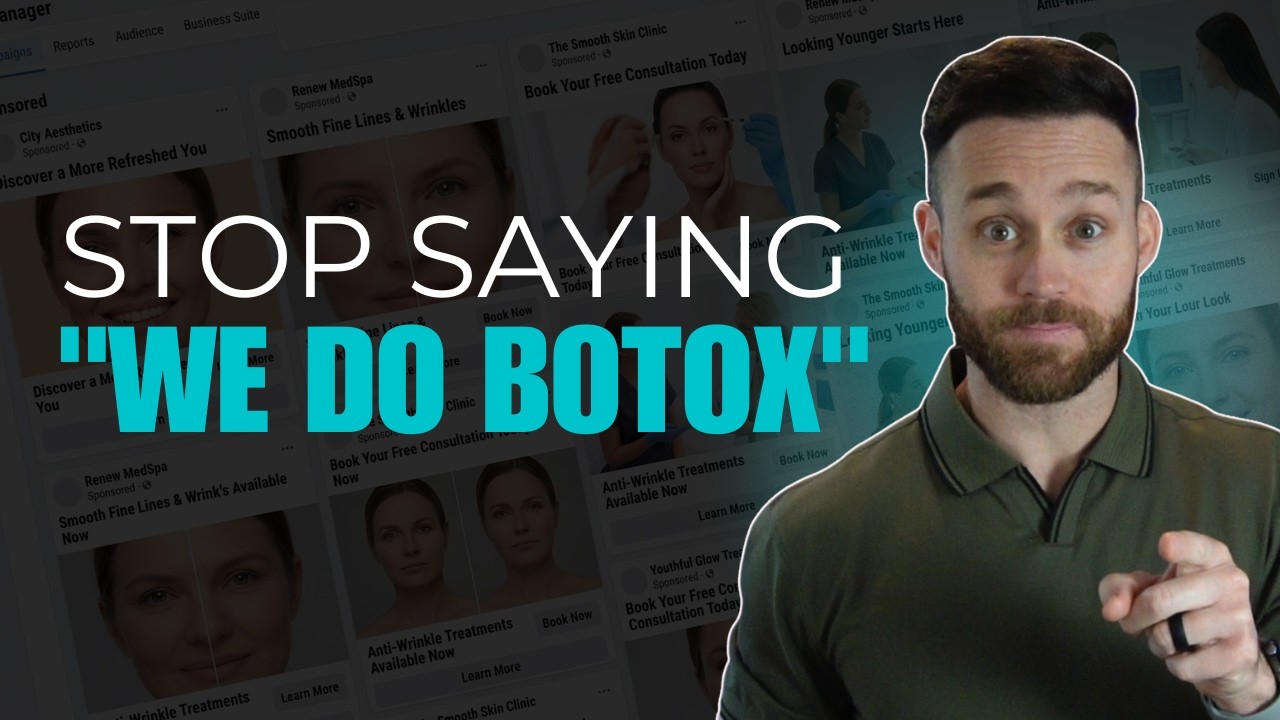
Saying “We do Botox and fillers” is not a marketing strategy. If your messaging is identical to every other med spa in your local market, you will inevitably get lost in the crowd. Sounding like everyone else is a recipe for disaster.
| Message Level | Example Positioning |
| Generic (Commoditized) | “We offer Botox and dermal fillers at competitive prices.” |
| Specific (Outcome-Driven) | “We help women 35–55 look refreshed without looking ‘done.'” |
The Generic Messaging Trap
When your core marketing message is generic, you leave yourself with only two levers to pull: price competition and reputation.
Competing on price creates a race to the bottom, attracting low-value, bargain-hunting clients who show little to no brand loyalty. While promotional price drops can work as a temporary hook to get patients through the door, living in that space permanently destroys profitability.
The Myth of the “Best Practitioner”
Many aesthetic injectors believe that superior technical skill automatically translates to business success. Unfortunately, the market does not necessarily reward the best practitioner; it rewards the clearest communicator.
I experienced this reality firsthand in my own career:
Personal Case Study: Shockley Marketing
Before rebranding to MedSpa Magic Marketing and building a full-service agency, I spent ten years (2012 to 2022) operating as an independent marketing consultant under the name Shockley Marketing.
During those ten years, I took my craft extremely seriously. I studied constantly, listened to marketing podcasts and audiobooks at the gym, and continuously honed my skills. I legitimately believed I was one of the top digital marketers in the country.
Yet, for a decade, I ran a tiny, one-man business. Why? Because despite my technical skill, I was not a clear communicator. I lacked a concise, compelling pitch that could reach the market at scale. My existing clients loved their results, but because my messaging wasn’t distinct, I missed out on massive growth opportunities.
If you are an exceptional aesthetic provider who is struggling to grow, you are likely falling into this exact same trap. To fix this, your pitch and value proposition must be irresistible and specific.
(Note: For an in-depth guide on constructing compelling offers, I highly recommend reading Alex Hormozi’s book, $100M Offers. It contains practical exercises to help transform your value proposition.)
Crafting a Distinctive Pitch
A powerful pitch begins with radical clarity. It steps away from listing deliverables (e.g., units of neurotoxin, syringes of filler, or laser wavelengths) and focuses entirely on the owned outcome.
Deliverables vs. Outcomes
When you broadcast generic messages like “We offer Botox,” prospects are left guessing about your practice’s values and expertise. Prospects assume your operational priorities align directly with the specific messaging you project into the world.
Ask yourself these clarifying questions about your positioning:
- Are you specializing in lip transformations for 24-year-olds?
- Are you focusing on comprehensive facial rejuvenation for women in their 60s?
- Do you cater to clients seeking a highly stylized, Los Angeles plastic-surgery aesthetic?
- Do you specialize in subtle, natural-looking enhancements where no one can tell the patient had work done?
Compare a generic deliverable pitch to an outcome-focused pitch:
- Generic: “We do Botox and fillers.”
- Outcome-Driven: “We specialize in helping women aged 35 to 55 look refreshed without looking ‘done.'”
The second statement immediately communicates who the service is for, the desired outcome, and the provider’s aesthetic philosophy.
Rethinking Introductory Offers
An effective introductory offer should excite your ideal patient and repel the wrong one.
Discount-based offers are popular because price is the easiest lever to manipulate on the patient buying matrix. Lowering price creates immediate volume.
The Patient Buying Matrix
Patients evaluate your practice based on three core criteria:
- Reputation (Trust, reviews, and clinical track record)
- Convenience (Location, accessibility, and booking ease)
- Price (The easiest variable to alter, but dangerous if used alone)
As you increase aggressive price promotions, you naturally increase the percentage of low-quality patients who are interested only in a bargain and will never convert into high-lifetime-value clients.
While high-volume discount strategies can still net a solid absolute number of quality patients due to sheer math (e.g., 5x total volume), relying exclusively on price cuts leads to staff burnout and practice frustration.
Injectables remain the financial lifeblood of most med spas and should form the core of your introductory offers. However, these offers must be wrapped in creative frameworks that attract long-term retention rather than one-time bargain hunters.
Agency Case Study: Rebuilding Our Value Stack
To illustrate how pitching impacts sales efficiency, consider an adjustment we made within our agency, MedSpa Magic Marketing.
Eighteen months ago, our agency was running a 6-to-7-week waitlist for new clients. Over the subsequent year and a half, our internal operations, data tracking, EMR integrations, and client results improved dramatically. Yet, recruiting new clients surprisingly became harder.
When I analyzed why, I realized the market had caught up, and we were doing an inadequate job of communicating our backend value.
On sales calls, our pitch defaulted to: “Our primary priority strategy is running Meta ads for your practice.”
To a prospect, that sounded identical to 97 other agencies claiming to “run Facebook ads.” I tried going into technical nuances to explain our superiority, but technical detail is not a concise way to go to market at scale.
To fix this, we reverse-engineered our services and built a clear, structured Value Stack:
MedSpa Magic Marketing 3-in-1 Value Stack
- Strategic & Marketing Consulting: We don’t just launch ads; we advise practice owners on offer strategy, pricing financial mechanics, positioning, and coaching through the validation phase.
- Custom Campaign Execution: Custom ad design, copywriting, creative testing, and continuous optimization built specifically for medical aesthetics.
- Data-Backed Infrastructure & ROI Tracking: We provide fully integrated EMR tracking and CRM systems that report direct return on investment (a standalone tool competitors charge $500–$600/month for).
Instead of pitching ourselves as “ad managers,” we repositioned our offering as a 3-in-1 Growth Program: strategic coaching, custom execution, and CFO-level ROI reporting. Reframing our pitch made our value obvious and restored our sales efficiency.
Pillar 2: Proof — Turning Your Pitch into a Promise
If your Pitch is what you claim to do, Proof is the evidence that converts that claim into a believable promise. Without proof, your pitch is just marketing noise.
High-Impact Social Proof Formats
To build a powerful proof engine, gather social proof assets that go beyond basic static images:
- Voiceover Transformation Videos: Video clip transformations accompanied by voiceover explanations of the patient’s journey and clinical approach.
- Patient Interview Videos: Video interviews where satisfied patients share their story—specifically highlighting what was lacking at previous clinics they visited and why your practice provided a superior experience.
- Contextual Google Reviews: Encourage reviews that mention specific treatments, providers, and results rather than generic five-star ratings.
The Danger of Pitch and Proof Misalignment
We recently observed this issue with a client practice in Texas. The practice owner is an exceptionally talented injector whose entire brand identity centered on facial dermal fillers. Her website, Instagram, and online reviews showcased lip and facial filler transformations almost exclusively.
When we launched a campaign to attract new Botox patients for her clinic, the campaign underperformed relative to our national benchmarks.
The issue wasn’t the ad setup—it was a misalignment between Pitch and Proof.
When prospective Botox patients clicked through to research her practice, every piece of social proof signaled that she was a filler specialist. Because the proof didn’t match the specific service being advertised, prospects hesitated to book. To maximize advertising efficiency, your proof assets must align directly with the specific treatment you are promoting.
Pillar 3: Promotion — Fueling the Engine
Once your Pitch is defined and your Proof is stacked, Promotion becomes the ultimate accelerator.
The Golf Analogy: Execution Strategy
Running promotions without a refined pitch is like attempting a complex golf shot without proper technique.
Consider a golfer playing the 13th hole at the Masters. The strategic play might call for a 3-wood off the tee, keeping the ball short of the trees with a slight draw. Knowing the strategy is easy; executing the shot requires skill. If an amateur golfer takes that same 3-wood, they risk pulling the ball into the water on the left or slicing it into the trees on the right.
In marketing, two practice owners can run the exact same campaign strategy, yet one achieves a massive return while the other loses money. The primary variable is rarely the advertising platform—it is the strength of the underlying pitch, the quality of the proof, and the precision of the execution.
Key Promotional Channels
- Meta Ads (Facebook & Instagram)
- Google Search & Local Service Ads
- Automated Email & SMS Campaigns
- Local Influencers & Strategic Partnerships
Once your foundation is built, these promotional channels act as fuel on the fire, accelerating your practice’s growth.
Summary & Action Items
Most med spas jump straight to promotion, neglecting the pitch and proof required to build a sustainable growth flywheel. To evaluate your current marketing, run through this three-step audit:
| Audit Focus | Core Evaluation Question |
| 1. Pitch Audit | Can you describe your unique outcome in one concise sentence that separates you from local competitors? |
| 2. Proof Audit | Do you have multiple deep, narrative-driven case studies and reviews that match your focus services? |
| 3. Promotion Audit | Are your ads pointing to a specific, branded transformation offer, or just linking to a price menu? |
1. Pitch Audit
Can you describe what you do in one sentence that makes you stand out in a crowded market?
If your answer is “We offer Botox and filler, and we do it really well,” it isn’t enough. Craft a message that defines your specific aesthetic approach or target patient outcome.
2. Proof Audit
Do you have multiple compelling case studies and transformations that back up your pitch?
You need far more than three static before-and-after photos. Focus on creating deep social proof assets, such as video interviews, voiceover transformations, and reviews that detail specific patient outcomes.
3. Promotion Audit
Are your ads and content pointing to a clear, specific offer, or simply linking to a generic price menu?
Take inspiration from high-performing practice menus that brand their services around complete transformations (e.g., specific treatment packages like a “Russian Lip” technique) rather than simply quoting a per-syringe or per-unit price. Selling artistry and outcomes is vastly superior to selling commoditized products.
Final Takeaway
If you choose to run a generic pitch—claiming only that you do the exact same procedures as every other practice, “just a little better”—you must be reputationally superior to every competitor in your area for that model to succeed.
For every other practice owner, true long-term growth requires going back to the drawing board. Refine your Pitch, stack your Proof, and then apply Promotion to scale your practice predictably.
(Be sure to check out Alex Hormozi’s $100M Offers for deeper frameworks on offer creation.)