- The 5-Step Framework: The Profitable Scaling Playbook
- Deep Dive: Offer Profit benchmarks
- Deep Dive: Operating Profit & The “Over-Profit” Trap
- Deep Dive: Mastering Cash Flow (The Metabolism of Money)
- Deep Dive: Customer Value and The “Bar Rescue” Strategy
- Tools: Which EMR has the Best Data?
- Responsible Debt Management
- The Solution for the “Busy but Broke” Practice
- The #1 Habit of Successful Owners
If you’re ready to implement more efficient & effective marketing strategies for your practice, book your FREE strategy session & marketing plan: https://go.medspamagicmarketing.com/schedule
You can do a million things right in your aesthetics practice—hire the best injectors, buy the best lasers, and build a beautiful facility—but if you don’t nail your financial management, everything eventually goes off the rails.
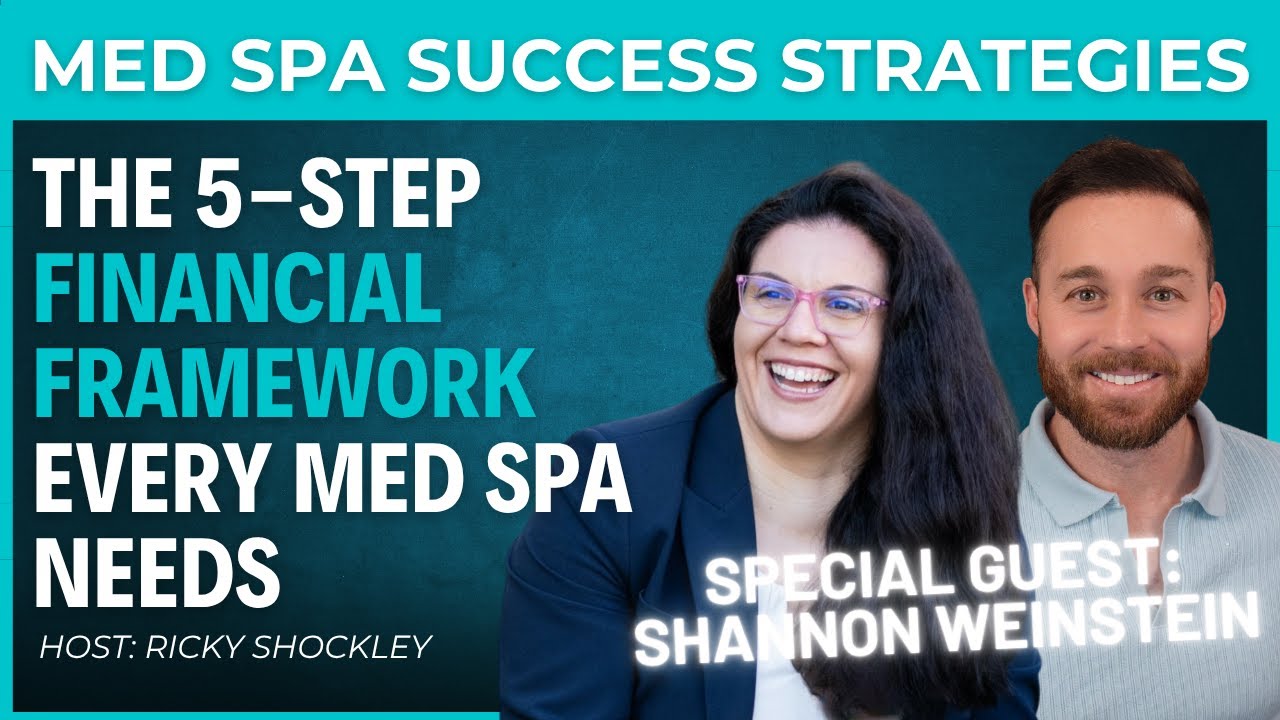
I recently sat down with Shannon Weinstein, a Fractional CFO for Med Spas and the host of the Keep What You Earn podcast. Shannon’s journey into finance is unique; she became a CPA after losing a bet with her dad, who taught her about money early on. In fact, she was running a McDonald’s by age 16. After 15 years in Big Four accounting and Fortune 50 finance, she now helps small business owners translate the language of finance.
While I usually approach business from the marketing side, this financial conversation is arguably the most critical. Marketing drives revenue, but finance determines whether you get to keep it.
Below is a detailed breakdown of Shannon’s “Profitable Scaling Playbook,” her five-step framework for troubleshooting a business, and the specific financial habits that separate struggling med spas from thriving empires.
The 5-Step Framework: The Profitable Scaling Playbook
Many practice owners feel overwhelmed by the sheer volume of data available to them. EMRs like Zenoti, Boulevard, and Vagaro provide endless reports, but data is useless without direction. To solve this, Shannon developed a hierarchy of financial health—an order of operations to identify exactly where the “clog” is in your business pipeline.
1. Offer Profit (Gross Margin)
This is the foundation. Fundamentally, are you selling your treatments for more than they cost you to deliver?
- The Rule: If you are not making money on a per-treatment basis, do not pass Go. Do not collect $200. Stop immediately.
- The Fix: If this is broken, scaling simply speeds up how fast you lose money. You must revamp pricing, lower supply costs, or adjust provider compensation plans before moving to the next step.
2. Operating Profit
Once your treatments are profitable individually, is the business profitable as a whole?
- The Scope: This covers the cost of running the actual business—rent, front desk staff, utilities, legal fees, accounting, and marketing.
- The Goal: Are you running a functional business that generates a surplus after the lights are kept on?
3. Cash Flow
Profit and cash flow are not the same. Cash flow is the metabolism of your business.
- The Mechanics: This involves the speed at which money comes in versus the speed at which it goes out. You must manage the timing of credit card payments, loan payments, and equipment financing against the timing of patient deposits and collections to ensure the bank account never runs dry.
4. Customer Value
You can have a profitable machine, but you need to put “paper” in the printer.
- The Focus: This is about Lifetime Value (LTV) and Customer Acquisition Cost (CAC). Are you upselling? Are you driving re-bookings and recurring revenue memberships?
- The Reality: You cannot rely on hustling for a new customer for every single Botox treatment. You need a model where customers spend more and stay longer.
5. Enterprise Value
Finally, we look at the big picture. Are you building an asset?
- The Strategy: Whether you plan to sell to private equity or keep the business as a cash cow, you should build it as if you are selling it. Buyers want a “golden goose” that lays eggs predictably. By focusing on enterprise value, you give yourself the choice to sell or scale.
Deep Dive: Offer Profit benchmarks
When analyzing Offer Profit (Gross Margin), we are looking for a healthy spread between revenue and the cost to deliver (COGS + Provider Labor).
The Benchmark: Generally, a cost of 30% to 40% on a blended basis is a good target. This means you are keeping 60% to 70% of your revenue after the direct costs of the service come out.
The “Margin + Market” Equation A common pitfall I see is owners obsessing over margin in a vacuum. You might have a service with incredible margins, but if there is no market demand for it, it is dragging you down.
- Margin: How much you make per unit.
- Market: The volume and demand for that unit.
If you have a treatment that people only need once a year, it is hard to justify dedicating a room or an expensive laser to it, even if the margin is high. Conversely, a lower margin service that acts as a volume driver might be more valuable to the overall ecosystem. You have to look at the blend.
Deep Dive: Operating Profit & The “Over-Profit” Trap
What does a healthy Med Spa look like in terms of operating profit? While it varies based on tax structure and owner involvement, we generally see a norm of 8% to 10% net operating margin.
However, Shannon offers a counter-intuitive warning here: If your margins are too high (20% to 25%+), you are likely under-investing in your business.
If you are taking home 30% margins, it usually indicates one of two problems:
- Founder Bottleneck: You are doing jobs as the founder that you should be hiring out.
- Stunted Growth: You are under-investing in marketing, tools, and people.
You have a machine that works; you should be reinvesting that excess margin to scale it, rather than just taking it all home in the short term.
Deep Dive: Mastering Cash Flow (The Metabolism of Money)
Profit is an accounting concept; cash is reality. You can show a profit on your P&L statement and still have $0 in the bank to pay payroll.
Why the P&L Lies to You Your P&L statement does not tell the whole story. Several massive cash exits do not show up on a P&L:
- Principal payments on equipment loans.
- Owner distributions and draws.
- Credit card payments (the expenses hit the P&L when you swipe, but the cash leaves when you pay the bill).
If all those payments hit on the 15th of the month, but your membership dues don’t hit until the 1st, your bank account will suffer even if you are “profitable.”
Tactics to Manage Cash Flow:
- Don’t Pay Early: Slow down the outflows. Do not pay credit cards early. Do not pay tax estimates early (which is essentially giving the IRS an interest-free loan). Keep that cash in your bank account working for you (e.g., investing in a new hire) as long as possible without incurring penalties.
- Speed Up Inflows: Take deposits. Keep credit cards on file for cancellation fees. Promote membership/recurring revenue to create predictable deposit spikes.
Deep Dive: Customer Value and The “Bar Rescue” Strategy
If your profits and cash flow are dialed in, but you are still struggling, the issue is likely Customer Value. You have a money printer, but no paper to put in it.
The “Regular” Threshold Shannon references a concept from the show Bar Rescue. The data showed that if you get a customer to visit a bar three times, they become a regular.
- Visit 1: They try it.
- Visit 2: They master the experience (they know the menu, the flow).
- Visit 3: It becomes a habit.
Your goal is to get them to that third visit as fast as possible.
The Zumba Analogy: “Second Class Free” Shannon used to teach Zumba and worked with a studio that had a unique policy: “Second Class Free.”
- Why not First Class Free? People take a free first class and never return. They have no skin in the game.
- The Logic: If you pay for the first class, you are invested. When you return for the free second class, you already know the choreography. You feel successful. You feel like you are winning. That feeling of success leads to the third class, which creates a “lifer.”
The Discounting Debate There is a massive debate in the industry about discounting. Does it cheapen the brand? My (Ricky’s) perspective is that if discounting lowers your Customer Acquisition Cost (CAC) significantly (e.g., getting 10 clients for $1,000 vs. 3 clients for $1,000), it is worth sifting through the “dirt” to find the gold.
Shannon agrees but adds a caveat: It must be a conscious trade-off.
- The Wrong Way: “20% off everything!” (This smells of desperation).
- The Right Way: Position the discount as a reward. Give a discount on a product because they booked their next appointment. Give a “Second Visit Free” to build a habit.
You must position the incentive as a thank you for behavior, not just a price slash.
Tools: Which EMR has the Best Data?
A common question is: Which software tracks these metrics best? Shannon’s answer: The one you can understand.
- Boulevard: Shannon’s close #1. User-friendly and great data visualization.
- Zenoti: An accountant’s dream. It is insanely powerful and collects massive amounts of data, but it can be overwhelming (“swimming in a sea of reports”) if you don’t know exactly what you are looking for.
Regardless of the tool, you must define your KPIs first to avoid drowning in data.
Responsible Debt Management
When is debt responsible? It’s not a question of when, but who.
Bad Debt vs. Good Debt
- Bad Debt: Using a line of credit to cover cash flow holes because you are losing money. This is like using a bucket to bail water out of the Titanic. You aren’t fixing the hole.
- Good Debt: Debt with a purpose. If you borrow money to hire a provider who will generate revenue in 3 months, that debt has a job.
“Dub and Knight Your Money” Shannon suggests giving your debt a specific title and purpose. “This is the Hiring Money.” “This is the Expansion Money.” Shannon learned this early on when her father gave her a credit card and told her, “That is not your money. That is someone else’s money you are borrowing.”
Warning: If you are fully debt-financed, your balance sheet will look unattractive to buyers. If you have $50k in cash but $45k in a line of credit, you are over-leveraged.
The Solution for the “Busy but Broke” Practice
What about the practice that looks successful—big team, busy office—but is constantly struggling with cash?
The Solution: The Weekly Cash Flow Forecast If you are struggling to sleep at night because of cash anxiety, use this simple forecasting method. You don’t need fancy software; a spreadsheet or even a napkin works.
The Sunday Night Protocol:
- Start with Monday’s Bank Balance.
- Map out the next 8 weeks (one column per week).
- Plot the Outflows: When is payroll? When is the rent? When is the credit card auto-pay? When are the loan payments?
- Plot the Inflows: Look at historical data. How much usually comes in during Week 1 vs. Week 4? When do membership dues hit?
- Calculate the Ending Balance.
As you do this weekly, you will get better at being “psychic.” This allows you to make decisions confidently. If you want to hire a new injector, plug their salary into the model. Does the ending balance turn red? If so, how much additional sales revenue do you need to cover it? Now you have a concrete sales goal.
The #1 Habit of Successful Owners
Finally, I asked Shannon what separates the practice doing $5M in revenue from the one struggling to get by.
The Answer: They consume data.
Successful owners do not operate on vibes or hope. They leave nothing to happenstance.
- They know their numbers.
- They A/B test ads.
- They track re-booking rates per provider.
- They know exactly what “good” looks like.
They Don’t Waste Money on Ego Shannon shared an example of a client who wanted to throw a massive community party/event with vendors. When asked why, the client admitted it was just to have a party. The result? Only existing patients showed up. It cost a fortune and brought in zero new revenue.
Successful owners don’t spend money on “fun” things that don’t drive results. They spend money on what the data says works.
If you want to scale, you must stop reacting to your bank balance and start proactively managing your data.
About Shannon Weinstein: Shannon is a Fractional CFO and CPA who helps small business owners translate the language of finance.
- Podcast: Keep What You Earn
- Website: keepwhatyouearn.com
This article is a production of Med Spa Magic Marketing. If you need help growing your practice through digital marketing, visit medspamagicmarketing.com.