
- What Defines a High-Value Med Spa?
- The Multi-Location Myth: Efficiency Over Expansion
- Operations: The “Blue Man Group” Model
- The Financial Benchmarks: What Good Looks Like
- Scaling: The “Dark Tunnel”
- Replacing the Working Owner (The Husband/Wife Dynamic)
- Current Market Valuation Trends
- Next Steps: The Skytale Pitchbook
If you’re ready to implement more efficient & effective marketing strategies for your practice, book your FREE strategy session & marketing plan: https://go.medspamagicmarketing.com/schedule
Whether your goal is to sell your medical aesthetics practice tomorrow, in ten years, or never, the blueprint for success remains the same. A business built to be sold is simply a business built to run efficiently, generate profit, and operate without the owner’s constant intervention.
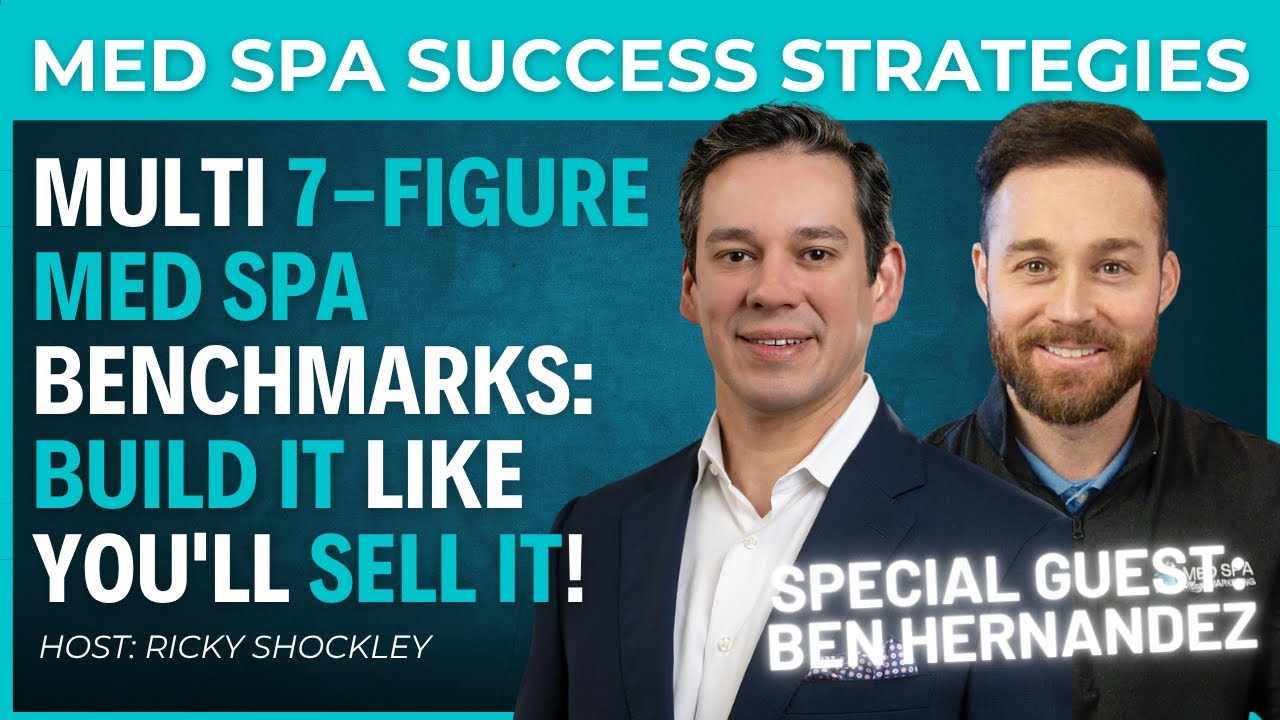
I recently sat down with Ben Hernandez, CEO and Managing Director of Skytale Group, a leading healthcare consulting and M&A firm. Ben brings deep expertise in healthcare consulting, mergers and acquisitions, and capital raising. Before founding Skytale, he held leadership roles in investment banking and hedge fund management.
In this deep dive, we explore exactly what investors look for in a high-value med spa, the specific financial benchmarks you need to hit (down to the percentage), and how to structure your operations to survive the “Dark Tunnel” of scaling.
What Defines a High-Value Med Spa?
When Skytale Group evaluates a business, they use an internal scorecard to grade practices green, yellow, or red. While financial performance is the baseline, the overarching theme of a high-value practice is simple: Have you de-risked the buyer?
Buyers and investors hate risk. Any operational or financial lever you pull that adds sophistication and stability to your business will be compensated for handsomely.
Here are the core components of a high-value asset:
1. Growth Trajectory vs. Stability
Financial performance is the starting point, but the direction of that performance matters immensely. You never want to sell a business that is declining.
- The Growth Premium: Investors are buying future cash flows. If you are growing at 10% year-over-year, an investor might pay a higher multiple (e.g., 6x) today. Behind closed doors, their investment committee justifies this because they know that in two years, that growth will “average down” their cost to a 3x or 4x multiple.
- The Stability Trap: A stagnant business can still be valuable if it is profitable and “bursting at the seams” (meaning you are maximizing revenue within your four walls). This is a safe bet for a buyer because you can’t mess it up. However, you will not get credit for future value in the form of a higher multiple or earn-outs because the growth story isn’t there.
2. Provider Diversification
If you are the owner and you generate the majority of the revenue, you present a massive “Key Person Risk.” If you get hit by a bus, the business evaporates.
A high-value practice has a diversified provider count. Ideally, an owner should generate only 10-15% of the revenue. This proves to a buyer that you have an operational model capable of recruiting, onboarding, and ramping up new injectors or estheticians successfully independent of the founder.
3. Service Mix & Recurring Revenue
You never want to be overly indexed in one specific modality, especially if it is volatile. A healthy, sellable mix often looks like this:
- 50-60% Injectables: This is highly valued because it acts as recurring revenue. Patients return roughly every 90 days. It is less “risky” cash flow compared to one-off treatments.
- Energy-Based Devices: These round out the portfolio with high margins.
- 10-15% Retail: This is critical because it proves patient loyalty. You only sell retail if patients trust and adhere to your protocols.
The Weight Loss Warning: Be cautious about being over-indexed in services like medical weight loss. If a practice is 60% weight loss, investors get spooked. FDA shortages or regulatory changes regarding compounding pharmacies could wipe out that revenue overnight. Weight loss should be a complementary service, not the foundation.
4. Market Leadership
Valuation is also influenced by your market position.
- Secondary/Tertiary Markets: If you are the market leader in a smaller town, you often face little competition. This usually results in high profitability and low provider turnover. Investors love this stability.
- Primary Markets (e.g., Miami, Dallas): Competition is fierce. To be valuable here, you must prove you can differentiate yourself and win against a med spa on every corner.
The Multi-Location Myth: Efficiency Over Expansion
There is a common misconception among practice owners that having three locations is automatically better than having one.
Ben’s Rule of Thumb: generally speaking, an investor would prefer a single location generating $2M in EBITDA over three locations generating that same $2M in EBITDA combined.
Why? Efficiency and Risk. Managing 15 people in one location is significantly easier, less capital-intensive, and less risky than managing 60 people spread across four locations. Multiple locations are only valuable if they share the same DNA, are efficient, and are all trending upward. If you have inefficient locations, the complexity hurts your valuation.
Operations: The “Blue Man Group” Model
How do you survive a top provider leaving? This is a major fear for owners, as patients are often loyal to the injector rather than the business.
Successful practices operate like the Blue Man Group. It doesn’t matter which “Blue Man” is on stage; the show is exactly the same. You need training protocols and Standard Operating Procedures (SOPs) that ensure the patient experience is consistent regardless of who holds the syringe.
When you have this level of consistency (similar to the Chick-fil-A model where the experience is identical in Boise or West Palm Beach), patients become loyal to the practice, not just the provider.
Retaining Top Talent in a Sale In the current M&A landscape, buyers are obsessed with provider retention. If you have an all-star provider, a deal might be contingent on them staying.
- Equity: We are seeing deals where owners give equity to key providers to retain them.
- Bonuses: Significant retention bonuses are often negotiated.
- Strategy: If you partner with key staff early (giving them “golden handcuffs” via equity or profit sharing), they think like owners. This makes the eventual sale much smoother because their incentives are aligned with yours.
The Financial Benchmarks: What Good Looks Like
If you want to run a profitable, sellable med spa, you need to govern your P&L statement by specific percentages. We typically see a 22% EBITDA margin (or higher) for a well-run business.
Here is the breakdown of exactly where your revenue should go:
1. Revenue Mix
- Retail Sales: Should be at least 10% of total revenue.
2. Cost of Goods Sold (COGS)
Your blended COGS should be roughly 20-25%.
- Injectables: ~40% COGS (Higher cost, but higher lifetime value and frequency).
- Lasers/Devices: ~10% COGS (High margin, but requires a patient acquisition model).
3. Payroll (The Most Common Leak)
Total payroll should be roughly 25% of total revenue.
- Providers: 15-20%.
- Support Staff/Admin: 5-10%.
- Note: If the owner is working in the business, their pay is included in this percentage.
4. Marketing
- Stable Growth: ~5%.
- Rapid Growth: This will be higher, but should normalize over time.
5. Rent
- Target: ~5% of revenue.
Where do people fail? Labor costs are where most practices go off the rails. Owners often over-hire in anticipation of growth that hasn’t happened yet, or they hire staff to replace themselves without analyzing the ROI of that replacement.
Scaling: The “Dark Tunnel”
If you are scaling from 2 locations to 5, 8, or 10, the math changes. You enter a phase Skytale calls “The Dark Tunnel.”
To manage a multi-site organization, you need an executive leadership team (COO, Director of Ops, Director of Marketing). These are expensive, non-revenue-generating roles.
- The Dip: When you hire this layer of management, your profitability (EBITDA margin) will dip temporarily. You are reinvesting cash flow into infrastructure.
- The Goal: This is acceptable if you understand it is an investment.
- Operating Leverage: Once you hit location 6, 7, or 8, you achieve operating leverage. That fixed leadership cost is spread across more revenue, and your margins expand again.
You have to be willing to walk through the “Dark Tunnel” of lower profitability to emerge as a scalable platform on the other side.
Replacing the Working Owner (The Husband/Wife Dynamic)
We often see husband/wife teams where one is the primary provider (e.g., the wife) and the other handles operations (e.g., the husband). How does this impact a sale?
The Provider (Wife): She is critical to revenue. In a sale, she will absolutely be asked to stay. Typically, buyers will require a contract (e.g., 4 years) ensuring her production and work schedule remain relatively consistent.
The Operator (Husband): This role is viewed differently. Buyers look at “Key Person Risk” regarding operations.
- The Exit: If he wants to leave, you must prove his responsibilities can be shed.
- The Fix: Document exactly what he does (payroll, recruiting, marketing). Over a period of 6 months prior to sale, train existing staff to take over these roles. If you can prove the team has handled these tasks successfully without him, he can exit (perhaps staying on as a consultant for a few months).
The “Add-Back” Nuance: When valuing a business, we “normalize” the owner’s compensation.
- If you pay yourself $0 on the P&L but take massive distributions, we adjust the P&L to reflect what it would cost to hire a replacement for you (at a market salary).
- If you pay yourself $500k but a replacement costs $200k, the $300k difference is added back to your EBITDA, increasing your valuation.
Current Market Valuation Trends
Despite economic fluctuations, valuations for healthy med spas remain steady and attractive.
- EBITDA Multiples: For a well-run founder-owned business profiting $1M+ (usually requiring ~$4M in revenue), multiples typically range from 6x to 9x EBITDA.
- Scarcity Premium: There is a scarcity of “platform-ready” businesses (high cash flow, clean operations). If you have scale, you command a premium.
- New Buyers: There are roughly 260-270 active buyer groups in the aesthetics space right now.
Qualitative Factors Matter It’s not just math. Due diligence is subjective. Buyers look at retention rates (the #1 KPI for operational health), culture, brand reputation, and recruiting processes. A high retention rate tells a buyer that your operations, chairside manner, and follow-up processes are working perfectly.
Next Steps: The Skytale Pitchbook
It is never too early to start planning for an exit, even if it is years away. Understanding the difference between a “lifestyle business” and a “sellable asset” will help you make better decisions regarding hiring, service mix, and expansion.
If you are interested in understanding the potential value of your practice, Skytale Group offers a complimentary process.
The Pitchbook Process:
- They review your financials.
- They highlight areas for improvement (e.g., “Your labor is high,” “Your service mix is risky”).
- They provide a general market valuation so you know exactly where you stand.
- They break down what a deal looks like (e.g., “A $10M offer usually means $7M cash, 30% equity rollover, and a 4-year employment agreement”).
Contact Ben Hernandez:
- Website: skytalegroup.com
- Email: ben.hernandez@skytalegroup.com
This article is based on an episode of the Med Spa Success Strategies podcast, a production of Med Spa Magic Marketing. We help aesthetics practices grow with effective digital marketing strategies. Visit medspamagicmarketing.com to learn more.