- The Origin Story: From HubSpot to Hydrafacials
- The Scaling Playbook: Integration and Standardization
- Operational Excellence: Managing Pricing and Geography
- Marketing Strategy: The Power of Events
- Trends vs. Fundamentals: The “Shallow Hal” Effect
- Data-Driven Decision Making: Breaking the Silos
- The Exit: Preparing for Private Equity
- Final Thoughts: Enjoying the Climb
If you’re ready to implement more efficient & effective marketing strategies for your practice, book your FREE strategy session & marketing plan: https://go.medspamagicmarketing.com/schedule
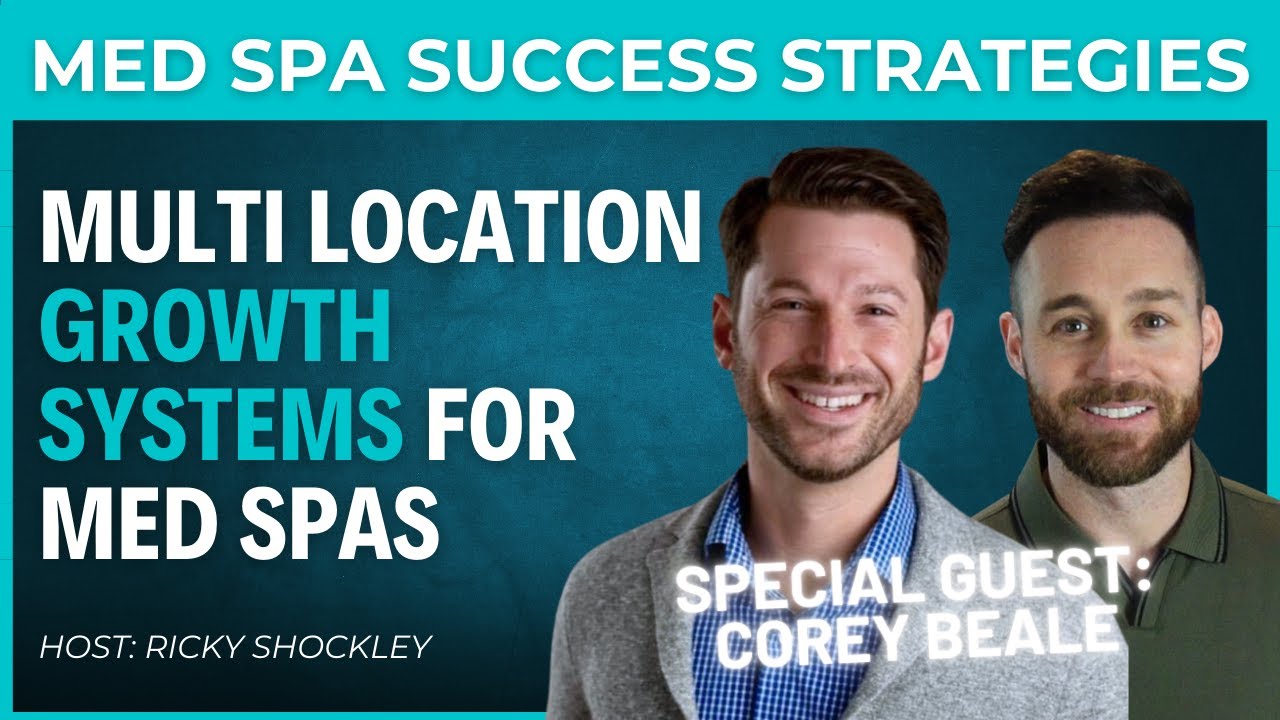
Welcome to the Med Spa Success Strategies blog. In a recent episode, we hosted Corey Beale, a seasoned sales and revenue executive with a unique background that bridges the gap between high-growth technology companies and the aesthetics industry.
Corey spent nearly 20 years scaling SaaS, fintech, and AI companies—including a decade as an early employee at HubSpot—before pivoting into the aesthetics space. His journey began as the very first franchise owner for MD Aesthetics, eventually leading him to join the corporate team as Chief Growth Officer. There, he applied software-scaling principles to brick-and-mortar operations, helping drive the brand to a successful private equity acquisition in mid-2025.
Currently, Corey serves as the Chief Revenue Officer at CorralData, where he continues to solve data challenges for the industry.
In this deep dive, we explore the specific strategies, operational playbooks, and data frameworks Corey used to scale MD Aesthetics.
The Origin Story: From HubSpot to Hydrafacials
Corey’s entry into the aesthetics space was born out of a desire for a “brain break” after two decades in the intense world of B2B software. Looking for a new challenge, he opened the first franchise location of MD Aesthetics.
His initial expectation was to operate a local business, but his executive instincts kicked in immediately. Within two months, he identified gaps in systems, marketing, and sales processes that were limiting scalability. He noted that stepping into the med spa software landscape felt like returning to the “on-premise” era of technology—a stark contrast to the modern cloud-based tools he was accustomed to.
This realization led him to join the corporate team, where he sought to answer a fundamental question: How much of the B2B SaaS playbook applies to a multi-location brick-and-mortar business?
The answer was: almost all of it. Corey realized that med spas effectively operate on a recurring revenue model similar to software companies.
- New Patient Acquisition is synonymous with New User Sign-ups.
- Retention and Rebooking are synonymous with Contract Renewals.
- Upsells and Cross-sells behave just like Account Expansion.
The Scaling Playbook: Integration and Standardization
Scaling from a handful of locations to a private equity-backed platform requires more than just capital; it requires a rigorous integration playbook.
The Acquisition and Diligence Phase
When MD Aesthetics acquired existing practices, they weren’t just buying a customer list; they were buying a mix of different cultures, service portfolios, and operational habits.
- Service Mix Challenges: Unlike dental practices which are fairly uniform, one med spa might be 90% injectables, while another is heavy on lasers or weight loss.
- The “Rip and Replace” Strategy: To achieve scale, the team often rebranded acquired locations digitally, physically, and systematically immediately upon takeover. This included transitioning EMRs (they eventually standardized on Zenoti) and aligning marketing channels.
The “Landing Team” Concept
Borrowing a specific play from his days opening international offices for HubSpot, Corey implemented “Landing Teams.” When opening or acquiring a new location, they wouldn’t just hand over a manual. They sent experienced injectors, managers, and front desk staff from their flagship location to the new site.
- The Goal: These individuals acted as culture carriers, setting the bar for performance, attire, and patient interaction from Day 1.
The Injector Academy
Consistency in service delivery is the hardest variable to control. To solve this, the founder, Mike Pedro, established an internal Injector Academy.
- The Problem: Most providers enter the industry via weekend Botox courses, which are insufficient for elite standards.
- The Solution: MD Aesthetics created a six-month training program involving multiple in-person visits and dozens of online modules. This served as a six-month interview process, ensuring only the top providers were hired.
Operational Excellence: Managing Pricing and Geography
One of the nuanced challenges discussed was managing pricing across different geographic locations.
The 20-Minute Rule
Corey highlighted the difficulty of managing locations that are geographically close (within 20 to 30 minutes of each other).
- Risk: If pricing varies significantly between close locations, you risk cannibalizing your own business as patients “shop” for the best per-unit price.
- Strategy: In dense regions, pricing must be tightly guarded and consistent. However, if locations are an hour or more apart, there is flexibility to tailor pricing to the specific income levels and competitive landscape of that local market.
Daily Operational Checklists
To maintain the “MD Way,” the team was maniacal about details.
- The Daily Audit: Front desk staff and managers utilized daily checklists that covered everything from the scent of the office to the specific direction products faced on the shelves.
- The Outcome: A patient could walk into any location and receive an identical brand experience.
Marketing Strategy: The Power of Events
When asked which marketing channel is most undervalued, Corey’s answer was immediate: Events.
However, success requires more than just posting a flyer on Instagram. The MD Aesthetics approach involved:
- Thematic Execution: Events were not generic open houses. They had specific themes (e.g., VIP nights, new patient introduction nights).
- Strategic Offers: Offers were planned based on trend lines—boosting services that were naturally slower during that time of year (like fighting the summer doldrums).
- Dedicated Personnel: They had a marketing team member specifically skilled in event execution who managed decor, invites, and the “run of show.”
- “Try Before You Buy”: The psychology behind events is lowering the intimidation barrier. It allows potential patients to enter the space, feel the vibe, and meet the team without the pressure of an immediate transaction.
Trends vs. Fundamentals: The “Shallow Hal” Effect
We discussed the surge of wellness trends like IV therapy, cryotherapy, and red light beds. While popular, Corey expressed caution regarding their business viability compared to core aesthetic services.
The Economics of Wellness
- Room Utilization: Marketing an IV drip often costs $150-$200 in ad spend to sell a service priced at $150 that occupies a treatment room for an hour. Without massive volume and cross-selling, the math is difficult to sustain.
- The “Shallow Hal” Effect: Injectables (Botox/Filler) have a visible, third-party verifiable result. If you stop getting Botox, you look different. If you stop cold plunging, nobody else knows. This creates a natural “stickiness” and retention for injectables that wellness services lack.
- Private Equity Standards: PE firms typically look for 60% or more of revenue to come from injectables because it is a proven, recurring revenue stream.
Data-Driven Decision Making: Breaking the Silos
Coming from the tech world, Corey was shocked by how siloed data is in the aesthetics space. Most owners operate out of disjointed spreadsheets, trying to manually connect data from their EMR, Google Ads, QuickBooks, and CRM.
The SaaS Funnel Approach
Corey tracked hundreds of KPIs, but focused heavily on funnel shapes:
- Acquisition Funnel: Lead > Consult Booked > Consult Show > Consult Convert > First Service.
- Retention Funnel: Rebooking rates, membership conversions, and reactivation of dormant patients.
He noted that making a good data-based decision at 9:00 AM could drive $10,000 to $50,000 in revenue by the end of the day. This agility is impossible if you are waiting for end-of-month reports.
The Solution: CorralData
This data problem led Corey to his current role as Chief Revenue Officer at CorralData.
- The Platform: CorralData is an AI-powered, HIPAA-compliant platform that integrates all systems (EMR, CRM, Financials, Ads) into a single data warehouse.
- The Benefit: It automates the analysis that used to take days of spreadsheet work, allowing owners to ask questions in plain English (e.g., “What is my customer acquisition cost by provider?”) and get instant answers.
The Exit: Preparing for Private Equity
For owners eyeing an exit, Corey shared his experience going through the acquisition process with Skytale Group.
Key Takeaways for Sellers:
- Get Your House in Order: Everything must be tight—leases, employment agreements, SOPs, and financials. Due diligence will uncover every crack in the foundation.
- It Is a Full-Time Job: The acquisition process is a massive distraction. You need a strong executive team to keep the business running and growing while you handle the deal. If the business slides during diligence, the valuation drops.
- Consistency is Value: Private Equity buys consistency and lack of risk. The more systematized and documented your business is, the higher the valuation.
Final Thoughts: Enjoying the Climb
We wrapped up the episode with a reminder for all business owners. The pressure of payroll, reviews, and growth is real, but it is vital to enjoy the process.
You started this business to create freedom and impact. Every challenge is part of the privilege of being an entrepreneur. Laugh with your team, celebrate the wins, and remember that you are building something that matters.
Resources Mentioned:
Med Spa Magic Marketing: For digital marketing, lead generation, and advertising strategy.
CorralData: https://corraldata.com/ – The data platform Corey is leading to help med spas integrate their systems.
Skytale Group: Strategic financial partners for scaling and exiting.