If you’re ready to implement more efficient & effective marketing strategies for your practice, book your FREE strategy session & marketing plan: https://go.medspamagicmarketing.com/schedule
In the aesthetics industry, there is often a distinct gap between clinical expertise and business acumen. How do you take a small practice and scale it into a multi-state empire? How do you navigate the complex, ever-changing legal landscape? And perhaps most controversially, does discounting actually hurt your brand, or is it the secret weapon to growth?
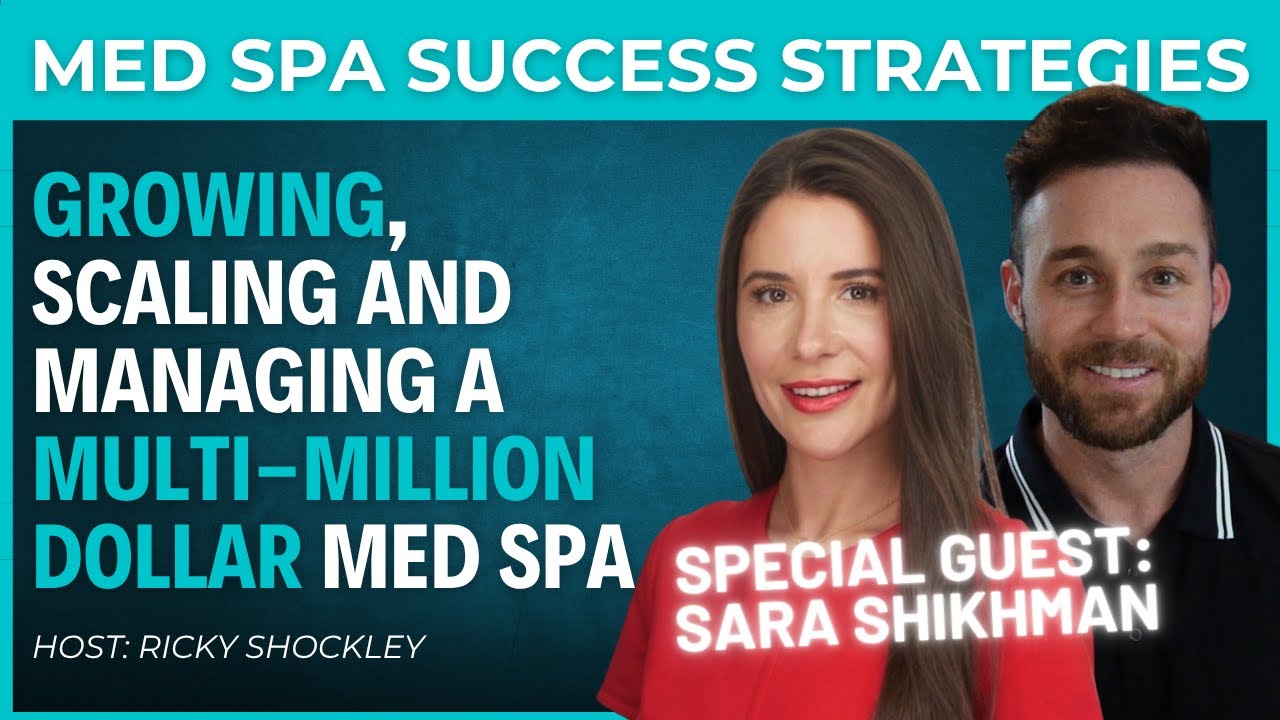
In a recent episode of the Med Spa Success Strategies podcast, we welcomed our first-ever three-time guest, Sara Shikhman, Managing Partner of Lengea Law. Sara is a healthcare attorney and entrepreneur with a resume that demands attention. She has led several multi-million dollar ventures, including an e-commerce company that generated over $13 million in revenue and a med spa that she expanded from a single room to 12 locations across multiple states, generating over $13 million in annual revenue.
In this deep dive, Sara pulls back the curtain on her specific scaling blueprints, offers a lawyer’s perspective on the current GLP-1 landscape, and shares her data-backed (and contrarian) views on pricing strategy.
The Origin Story: Starting Small and Scrappy
Before entering the med spa space, Sara was a corporate attorney who transitioned into entrepreneurship, co-founding an e-commerce furniture company that did $12 million in revenue selling across all 50 states. When her husband, a physician, expressed interest in opening a med spa, they decided to combine his medical background with her business and marketing expertise.
They didn’t start with a massive facility or a private equity injection. They started in one semi-finished room in a building her husband owned in downtown Columbus, Ohio. The neighborhood wasn’t the greatest, and the beginnings were humble.
Sara recalls that one of their very first “model patients” used for training was actually her ex-boyfriend, brought in by his new girlfriend. It highlights a universal truth about the early days: you use the resources you have, you get scrappy, and you do what it takes to get off the ground.
Bridging the Business-Medical Gap
One of the most common points of failure in this industry occurs when a practice is lopsided—either led by a business person with no medical understanding or a provider with no business background.
Sara’s success came from having both sides covered: a doctor (her husband) and a business operator (herself). However, for those flying solo without a partner to fill the gap, her advice is clear:
“If you just have one and not the other, it’s super hard. Find a really good business consultant or marketing agency. Be very clear about what you’re hiring them for. You could figure these things out yourself and spend $10,000 in six months making mistakes, or you can hire a consultant for $5,000 and get it done in two months.”
The Blueprint for Scaling: Grow at the Speed of Demand
A major trap for new owners is over-leveraging early on. In her book, Med Spa Confidential, Sara advises readers to “start small,” a philosophy she stands by regardless of your ambitions.
Financial Discipline: The SBA Loan Trap
Even if you qualify for a $250,000 or $300,000 SBA loan, Sara advises against spending 50% or more of it on a lavish buildout or depreciating assets like lasers.
“Once you buy a laser, if you want to sell it one month later, you’re going to get 40% of it back, maybe 20%,” she warns. Instead, she recommends deploying that capital toward marketing and team building—assets that generate immediate ROI and can’t be repossessed.
The Expansion Journey
Sara’s practice grew from that single room in Columbus to a multi-state operation through calculated, incremental steps:
- Phase 1: One room in a building they owned in Columbus.
- Phase 2: Expanding to New York by finding a chiropractor on Craigslist and renting one room in her office.
- Phase 3: When patient volume overwhelmed the chiropractor’s waiting room (turning it from a quiet medical office to a bustling med spa), they took over a law office in the same building to get two dedicated treatment rooms.
- Phase 4: Expanding into additional rooms in the original Columbus building and eventually opening a second location in Columbus about 20–30 minutes away.
When to Open a Second Location
Sara notes that if she didn’t have strong personal ties to New York, she would advise keeping locations close geographically to avoid the burnout of constant travel. Furthermore, she warns against expanding too soon.
“A two-location business is three times more complicated than a one-location business,” she explains. You encounter inventory issues, people issues, and the loss of the owner’s physical presence to put out fires.
The Strategy: Do not open a second location just to say you have one. A single location generating $5 million is far easier to manage and more profitable than two locations generating $2.5 million each. Only expand when you are truly tapped out in your current space or need to access a distinct population center.
Operations: Standardizing the Experience
As you scale, maintaining consistency is the biggest hurdle. This is where the legal mind meets business operations. Sara’s advice is simple: Write it down.
To scale effectively, you need detailed Standard Operating Procedures (SOPs) for everything:
- How to open the office.
- What color paint is used in the bathroom.
- How to greet patients.
- Specific injection patterns and dosing protocols (e.g., maximum units for a forehead).
Breaking Provider Dependency
A common fear in the industry is that patients are loyal to the provider, not the brand. If that provider leaves, the revenue leaves with them. Sara suggests three strategies to combat this:
- “First Available” Booking: Structure your booking software to prioritize the first available appointment rather than forcing a client to select a specific provider.
- Flash Sales: Run promotions specifically to drive traffic to other providers (e.g., “20% off with Provider B this week”).
- Standardized Protocols: This is crucial. If every provider follows the same strict treatment protocol, the patient experience becomes consistent regardless of who holds the syringe. This reduces the fear of switching providers and, legally speaking, reduces liability by minimizing “freestyling.”
Retention and Culture: Keeping Your Team
If you build a great team, how do you keep them from leaving and becoming your competition? Sara shared specific compensation models she uses for her legal clients to lock in top talent.
1. Retention Bonuses
Instead of a standard raise, implement a tiered retention bonus that rewards longevity.
- Year 1: $5,000 bonus
- Year 2: $10,000 bonus
- Year 3: $20,000 bonus
- Year 5: $30,000 bonus
2. Phantom Equity
For key players, you can offer “phantom equity.” This serves as a promise of a payout in the event of a future sale (e.g., 3% or 5% of the sale price). It aligns the employee’s incentives with the owner’s goal of an eventual exit without giving up actual ownership shares today.
3. Culture and Boundaries
While Sara believes that people are inherently good, she warns against blurring the lines between “boss” and “best friend.”
“It is much harder to enforce policies with friends,” she notes. If you are drinking buddies with your staff, it becomes difficult to reprimand them for showing up late or violating policy. Furthermore, alcohol-fueled corporate events are a liability minefield for harassment and discrimination lawsuits. Her advice: Be compassionate and kind, but keep it professional.
The Great Debate: Discounting and Price
One of the most controversial topics in the industry is discounting. Many consultants argue that discounting cheapens the brand and attracts “bad” clients. Sara strongly disagrees, and she has the data to back it up.
When analyzing her own med spa’s data to determine who should receive handwritten holiday cards, she pulled a list of her top 20% highest-spending clients—those spending $10k, $20k, or $25k.
The Result: Approximately 80% of those VIP clients originally came from Groupon.
The Math Over The Ego
Discounting is a customer acquisition tool. It lowers the barrier to entry and gives you more “at-bats.”
- The Net Strategy: Yes, you will attract some bargain hunters who never return. But if you cast a wide net, you will also catch high-value patients who just needed a low-risk reason to try you out.
- Reputation vs. Offer: In a saturated market where every med spa has a beautiful buildout and 5-star reviews, a compelling offer is the tie-breaker.
- New Products: With the availability of newer, more affordable neurotoxins (some around $45/vial), practices have more margin to run aggressive promos than ever before.
- Free Consultations: Sara applies this to her law firm as well, offering free 15-minute consultations. While some peers refuse to work for free, she views it as a necessary loss leader to demonstrate value and win the relationship.
The Legal Landscape: The GLP-1 Update (May 2025)
We shifted gears to discuss the critical topic of Semaglutide and compounded GLP-1s. As of May 2025, the regulatory environment has shifted dramatically.
The Deadline: May 22, 2025, was the deadline regarding Semaglutide compounding. The Reality: The shortage is officially over. This means that legally, compounded versions of these drugs should not be produced unless there is a specific, documented medical need for a compounded variation (e.g., a patient has a documented allergy to an inactive ingredient in the brand name drug).
The Risk
Pharmaceutical giants like Eli Lilly and Novo Nordisk are aggressively protecting their patents. They are filing complaints and lawsuits against med spas and compounding pharmacies to bleed them dry with legal fees.
While some compounding pharmacies are telling practices, “It’s fine, we’re appealing it in court,” Sara warns that this does not protect the practice owner.
- The Pharmacies: Many are still taking orders but engaging in long shipping delays or fighting legal battles they are unlikely to win.
- The Advice: To sleep well at night, practices should transition their weight loss programs to the brand-name drugs. While more expensive for the consumer, it removes the risk of a federal patent lawsuit that most small practices cannot afford to defend.
Final Thoughts
Whether you are in a single room or scaling to your tenth location, the principles remain the same: know your numbers, standardize your operations, protect your business legally, and don’t be afraid to use aggressive marketing to acquire customers.
About Sara Shikhman & Lengea Law
Sara and her team at Lengea Law assist med spas with formation, employment contracts, MSOs, selling practices, and compliance audits. They offer memberships as well as one-off hourly consultations for specific issues like GLP-1 compliance.
- Website: LengeaLaw.com
- Book: Med Spa Confidential (Available on Amazon)
For more strategies on growing your aesthetic practice, visit MedSpaMagicMarketing.com.