If you’re ready to implement more efficient & effective marketing strategies for your practice, book your FREE strategy session & marketing plan: https://go.medspamagicmarketing.com/schedule
In the world of Med Spa growth, we often treat marketing as a “blank canvas.” There are countless directions we can take, and marketing can accomplish a vast range of objectives for your practice. However, the most critical element—the one that determines whether your investment feels like a win or a waste of money—is alignment.
I recently sat down with my team to analyze the performance of a specific client. We were looking at campaigns that were hitting historical highs alongside others that were struggling to gain traction. Through that discussion, it became clear that calling a marketing strategy “successful” or “unsuccessful” is often too black and white.
Success is not a universal metric; it is a moving target that depends entirely on your business goals, your risk tolerance, and the trade-offs you are willing to make. Today, I want to pull back the curtain on those trade-offs and help you find the alignment you need to scale effectively as we head into 2026.
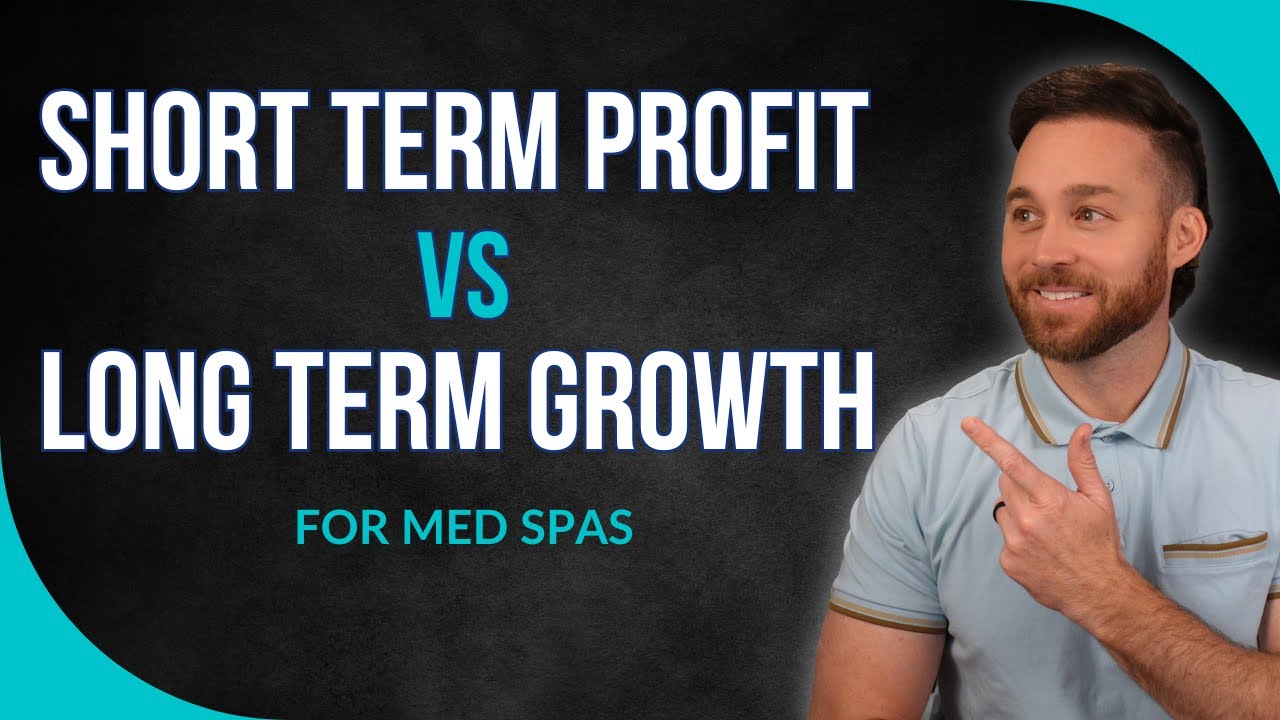
1. Long-Term Revenue Growth vs. Short-Term Profitability
When marketing agencies share case studies, they often stick to surface-level results, like the number of new patients acquired. But that only tells a small portion of the story. To find true alignment, we have to look deeper: What types of patients are we getting? How much are they spending? Are they recurring?
The first step in alignment is deciding if you are trying to maximize profitability on an individual interaction today, or if you are positioning the practice for maximum growth 24, 36, or 48 months from now.
The Short-Term Profitability Trap
Let’s use Emsculpt as the quintessential example. If you sell a $5,000 Emsculpt package with a $1,000 customer acquisition cost (CAC), you’ve created a massive profitability gap on that initial sale.
However, look at the volume. If you spend $10,000 a month on ads with a $1,000 CAC, you are only seeing 10 new clients per month. While you may generate $40,000 to $50,000 in immediate revenue, you aren’t building a massive database. You are not building a client base that is coming back for recurring services at an efficient rate years down the road.
The Long-Term Growth Play
If your goal is to maximize long-term growth, you need to lean into a different strategy: building an injectable client base. You want a high volume of people coming back to your practice three or four times a year, spending $1,500 to $2,000 annually. This puts the business in the best possible position for revenue growth in the years to come.
You can find a “middle ground” in the gray area between these two, but you must understand that the extremes require very different marketing directions.
2. Quantity vs. Quality: The Math of “Butts in Seats”
One of the most common debates in Med Spa marketing is Quantity vs. Quality. Many owners say they only want “high-quality” leads, but optimizing for quality upfront often results in slower growth.
The “Sifting” Strategy
When we use a discount-based strategy to get “butts in seats” for injectables, the math often favors the practice.
- The Scenario: You spend $1,000 to see 10 clients.
- The Quality Gap: Out of those 10, let’s say 6 are “discount shoppers” who will jump to the next facility for a better deal next month. However, 4 of them are high-quality clients who will stay with you.
- The Effective CAC: Even though 60% of the leads weren’t “quality,” you still acquired 4 good clients for $1,000. That is an effective CAC of **$250 per good client.**
The Quality-First Strategy
If you try to optimize for quality upfront to avoid the “deal hunters,” you might only see 3 clients for every $1,000 spent. Your CAC is now $333, and you are seeing a smaller absolute volume of people. Long-term, this means fewer people in your recurring revenue model.
3. Risk Tolerance and Provider Alignment
If you choose the “Quantity” strategy—which I often call sifting through the dirt to find the gold—you have to manage the risks associated with it. I don’t mean to call patients “dirt,” but some are simply transient shoppers. The risk here is how this affects your team.
Protecting Your Providers
- Burnout and Experience: Are your providers having a bad experience because their schedules are full of discount shoppers who “ruffle feathers”?
- Commission Structures: Does a schedule full of low-margin visits screw with your team’s comp structure?
- Google Reviews: Are you risking negative reviews by bringing in a high volume of people who are primarily price-sensitive and potentially more difficult to please?
If you have a “green” injector who isn’t skilled at explaining services or handling difficult personalities, the quantity strategy might throw a wrench in your system. But if your providers are “killers” at retention and delighting patients, you can lean into high-volume strategies with confidence.
4. The “$29 Facial” and the Power of “At-Bats”
A great tactical example of this alignment is the introductory facial. Suppose you run a $99 introductory facial ad and your CAC is $99. You are breaking even on the first visit. Now, suppose you drop that price to **$29**. Because it’s so much more attractive, your CAC drops to $29.
You still aren’t making money on the initial visit, but you are now seeing triple the number of clients. If your internal strategy is dialed in and your esthetician is great at cross-selling and upselling, you want those extra “at-bats.” You want as many opportunities as possible to thrill a patient and move them into a top-tier premium service.
5. Reverse-Engineering Your Business Goals
You should never jam a square peg into a round hole just because you want to sell a specific service. If you want to sell more microneedling packages, the best way to do that is often to build your injectable base first. Once patients know, like, and trust you, they are far more likely to buy your premium services at a standard price point.
Who Needs to Be Busy?
Your strategy should also evolve based on your current roster:
- Busy Providers: If a senior provider is already at capacity, don’t fill their schedule with new discount patients. It’s unnecessary.
- New Providers: If you’ve just hired a new injector, use an aggressive discount to fill their book quickly and get them the experience they need.
The Pet Spa Lesson
My wife and business partner, Mary, once managed a high-end pet spa in West Palm Beach. Her boss used a brilliant strategy: because they were the new business in town and didn’t have a reputational advantage, they were the cheapest. They provided an exceptional, luxury experience at the lowest price in town. As they built their reputation and the demand increased, they elevated their price points.
Final Thoughts: Calibrating for 2026
The takeaway for today is simple: Your marketing must be a reflection of your growth goals. Have big-picture conversations with your marketing team. Talk about where you are now, who needs to be busy, and which services you truly believe in. Balance short-term ROI with the need for maximum “at-bats,” and don’t be afraid to adjust the dial as your business evolves.