If you’re ready to implement more efficient & effective marketing strategies for your practice, book your FREE strategy session & marketing plan: https://go.medspamagicmarketing.com/schedule
If you are running Facebook and Instagram ads (Meta ads) for your Med Spa, you likely know they are one of the most cost-effective ways to grow your practice. However, simply “running ads” isn’t enough. Inefficiencies in your strategy—whether it’s your offer framing, your creative, or your follow-up—can cost you hundreds of thousands of dollars in lost revenue over time.
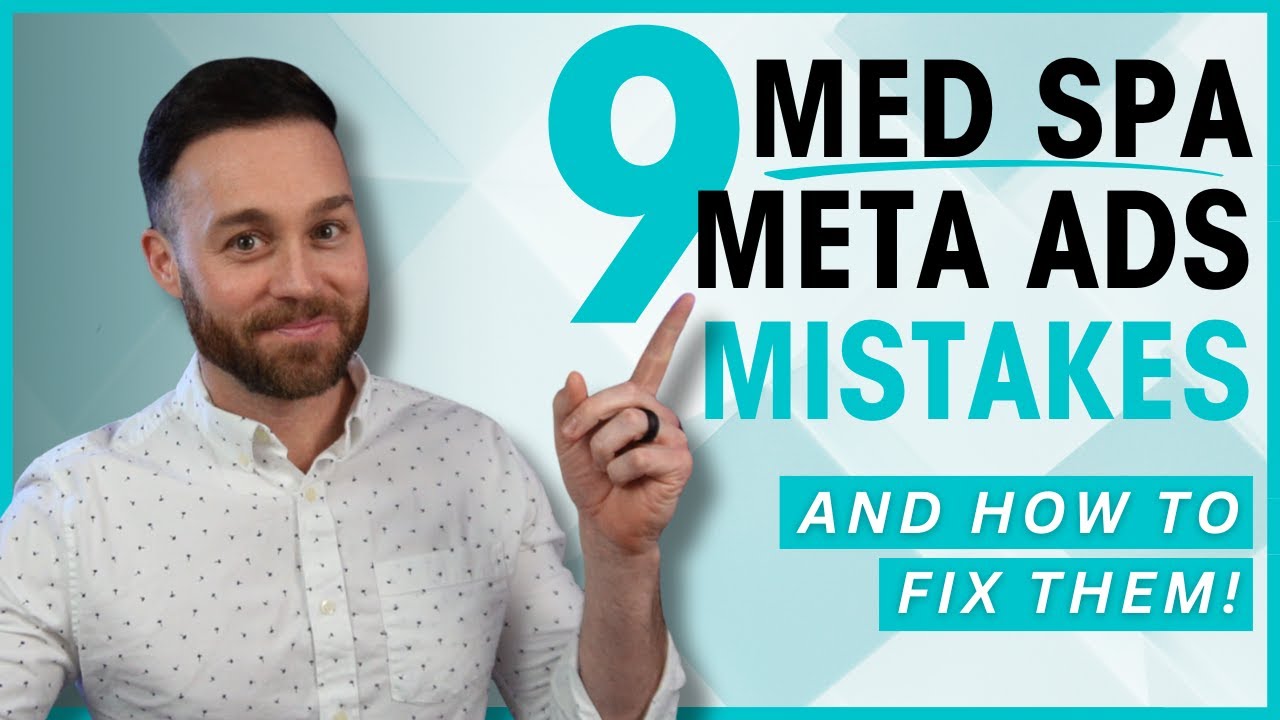
I’ve been consulting with Med Spas for over a decade, and today I’m breaking down the nine specific reasons why your ads might be struggling. Whether you are currently running ads or planning to launch them soon, this framework will help you optimize for peak performance.
1. You Are Not Well-Positioned (The Med Spa Selection Matrix)
The first issue often has nothing to do with the ad platform itself—it’s about your market positioning. Your prospects (people new to town, those new to aesthetics, or those thinking about switching providers) are running a mental calculation before they choose you.
We call this the Med Spa Selection Matrix. Think of it as a score from 1 to 100 that a prospect assigns to your business based on three weighted categories:
- Reputation & Affection (50%): Do they know, like, and trust you? Do you have a perfect 5-star rating on Google, or are you sitting at a 4.7 while your competitors are perfect 5s?
- Convenience (30%): Is your practice a mile from their house, or are you 27 miles downtown?
- Price or Promotion (20%): Is the offer compelling enough to break their current habits?
The Problem: If you are not maximally attractive on this scale, you will struggle. For example, if you are targeting people 45 minutes away (low convenience) and you have a subpar reputation compared to competitors in their area, you are fighting an uphill battle. You must optimize for attractiveness in all three buckets to give people a compelling reason to choose you as their new Med Spa home.
2. Your Offers Aren’t Exciting Enough
There is a basic, inescapable matrix in advertising: The cost to acquire a customer goes down when the attractiveness of your offer goes up.
Many owners try to ignore this because they don’t want to discount, but the data is undeniable. Let’s look at two real-world examples from our clients to illustrate this.
Case Study A: The Reputation Ad vs. The Discount Ad
We ran a split test for a client:
- Ad A (Reputation): An invite for a consult (trying to win on reputation alone).
- Ad B (Discount): A new patient discount on Dysport.
The Result: We paid 2.5x more per lead and almost 3x more in Customer Acquisition Cost (CAC) on the reputation ad compared to the discount offer. For every 1,000 impressions, the discount offer brought in 10 to 15 clients, while the reputation ad brought in only 3 or 4.
Case Study B: The $10 Difference
Another client was running a new patient Botox offer: 20 Units for $179. Their cost per lead was $24. We lowered the promo price by just $10, making it 20 Units for $169.
The Result: The lead cost dropped by 9%. While that sounds small, when you plug it into an ROI calculator, it meant their Customer Acquisition Cost dropped from $160 down to $100 (assuming a 15% close rate). By giving up just $10 in price, they saved $60 in acquisition costs.
The Takeaway: You pay for the customer on either side of the equation—either in the discount or in the ad spend. It is often more profitable to give the discount. Remember the quote: “Action changes attitude faster than attitude changes action.” If you want to be someone’s favorite Med Spa, you have to get them through the door first.
3. Offer Framing Issues
Sometimes the offer itself is fine, but the way you present it (the framing) is wrong. Small tweaks in how an offer is structured can lead to massive differences in volume.
Case Study: The Miami Dysport Pivot
We had a client in Miami who wanted to run a Dysport offer.
- Original Frame: A “Classic Dysport Package” (Forehead, Glabella, Crows Feet) for $599.
- Result: Cost per lead was $37.
- New Frame: We switched to a Unit Price strategy: Dysport for $4.50 per unit.
- Result: Cost per lead dropped to $13.
We saw triple the volume of patients just by changing the framing. Even though the average ticket might be slightly lower on the unit price offer, the drastic reduction in acquisition cost made it significantly more profitable.
Things You Should Test:
- Unit Price vs. Bundled Price: Test $9/unit vs. “20 Units for $179.”
- Dollar Off vs. Percentage Off: Test “$50 Off” vs. “20% Off.”
- “Buy This, Get That”: Example: Buy 40 units, get 20 free.
- Combo Offers: Example: Botox + Facial for $275 (great for patient quality).
Don’t just “set it and forget it.” Small differences piled up over 24 months can equate to hundreds of thousands of dollars in revenue difference.
4. Creative Fatigue and Quality
Even with the right offer and framing, the visual asset (the creative) can be the bottleneck. You could have the exact same offer, but one image performs drastically better than another.
The Data: We have seen instances where simply changing the creative—the photo, the font style, the color scheme, or the headline placement—cut the lead cost in half. In one specific example with a Dysport promo, a creative refresh dropped the cost per lead from $32 down to $16.
Creative Elements to Test:
- Authentic provider photos vs. stock models.
- Headline sizing and positioning.
- Color schemes and font styles.
If your ads are stalling, do not assume the offer is broken. It might just be time for a visual refresh.
5. Weak Ad Copy
Your ad copy needs to do more than just state the offer. If your copy just says, “Claim $100 off filler by filling out this form,” you are missing an opportunity to build the “Know, Like, and Trust” factor.
You want to tell a compelling story about why a prospect should choose you as their med spa home.
Example of Compelling Ad Copy: Instead of just listing the price, try something like this:
“Hi, I’m [Name]. If you’re looking for a Med Spa home, I’d love to meet you. My clients count on me for three things: exceptional results, honest advice, and a relationship they can trust.
I take education and expertise seriously, and I believe your experience should feel welcoming, personal, and empowering—never salesy or surface level. If you are looking for authentic recommendations, fair pricing, and a provider who genuinely cares about helping you look and feel your best, I’m here for you.
We are rated 5 stars on Google. Here is a little more about me…”
This approach builds an emotional connection and distinguishes you from the commodity providers down the street.
6. Poor Follow-Up and Conversion
Leads from Meta are “interruptive.” These people did not wake up today actively searching for your service; they were scrolling through their feed and you caught their attention. Because of this, 80% of these leads might not be serious about booking immediately.
The Trap: If your team is manually calling, texting, and emailing every single lead, it becomes an enormous time suck with little return.
The Solution: Automate Until Interested You need a system that automates the follow-up process via text and email. Your staff should only spend time conversing with prospects who have raised their hand, replied to a text, or requested a booking.
- Speed to Lead: Critical. Automation ensures the first touch happens instantly.
- Method: Keep it text-heavy. Phone calls are icing on the cake, but SMS drives the highest engagement.
7. Advertising the Wrong Services
Sometimes, you are trying to fit a square peg into a round hole. Certain services are incredibly difficult to advertise cost-effectively on Meta because the targeting mechanisms aren’t precise enough for them.
Services that Struggle on Meta:
- Laser Hair Removal: Hard to target; low response rate unless heavily discounted.
- Tattoo Removal: Very niche; hard to find the right person at the right time.
- Microneedling: Often requires heavy discounting to work.
- Standalone Hydrafacials: People hop around for deals; retention and loyalty are notoriously low.
Services that Work Best:
- Injectables (Botox, Dysport, Filler): High retention. Once a client trusts you with their face, they function like a hair salon client—they don’t want to switch.
- Body Sculpting (CoolSculpting): High ticket value.
- Weight Loss Programs: Broad appeal.
The Strategy: Focus your ad spend on acquiring injectable clients (high loyalty), then cross-sell them the other services like Morpheus8 or lasers once they are in your ecosystem.
8. Improper Expectations and Analysis
Do you know what “good” results look like? Many practice owners don’t, which leads to bad decision-making.
Rough Benchmarks for Success:
- Botox/Dysport Lead Cost: $10 – $20.
- Customer Acquisition Cost (CAC): Should be $150 or less (we often see $50-$60).
If your lead cost is $50 for Botox, your offer likely isn’t attractive enough.
The ROI Trap (Injectables vs. Packages): I often hear owners say, “The math doesn’t make sense. There’s no ROI on the first visit for this Botox promo.”
They are right—you usually won’t make a profit on the first visit for a discounted injectable promo. That is not the goal. The goal is retention and lifetime value (LTV). It is like a restaurant sending out a “Buy One Entree, Get One Free” mailer. They lose money on that first dinner. But if the food is good, you come back for a second, third, and fourth visit at full price. That is where the ROI is created.
Exception: For package sales like CoolSculpting, you can measure ROI on the first visit. If you spend $1,000 on ads and sell a $5,000 package, that campaign is profitable immediately. Do not pause these ads just because lead costs seem high—look at the revenue generated.
If you want a free copy of our ROI Calculator to project these numbers yourself, email me at ricky@medspamagicmarketing.com.
9. Lack of Tracking
Finally, you cannot improve what you don’t measure. If you lack tracking, you lack confidence. And if you lack confidence, you won’t invest enough to grow.
You need to know:
- How many leads converted?
- What did they spend on the initial visit?
- How many were retained after 90 days?
How to Track: We work to integrate EMRs into our marketing CRM (GoHighLevel) so data is accessible in real-time. However, even if you are doing this manually in a spreadsheet, you must track the numbers.
When you track properly, you realize that marketing is an investment, not an expense. If it’s an expense, you shouldn’t be doing it. If it’s an investment, you should be scaling it.
Need Help Implementing This? If you want help fixing these issues or are looking for a new marketing partner, I’d love to chat. You can visit our website at medspamagicmarketing.com to schedule a 90-minute strategy and consulting session with me.